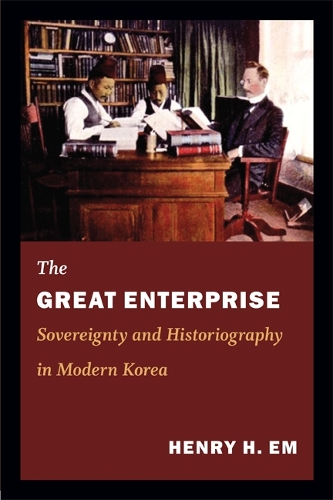
In The Great Enterprise, Henry H. Em examines how the project of national sovereignty shaped the work of Korean historians and their representations of Korea's past.
In The Great Enterprise, Henry H. Em examines how the project of national sovereignty shaped the work of Korean historians and their representations of Korea's past. The goal of Korea attaining validity and equal standing among sovereign nations, Em shows, was foundational to modern Korean politics in that it served a pedagogical function for Japanese and Western imperialisms, as well as for Korean nationalism. Sovereignty thus functioned as police power and political power in shaping Korea's modernity, including anticolonial and postcolonial movements toward a radically democratic politics.
Surveying historical works written over the course of the twentieth century, Em elucidates the influence of Christian missionaries, as well as the role that Japan's colonial policy played in determining the narrative framework for defining Korea's national past. Em goes on to analyze postcolonial works in which South Korean historians promoted national narratives appropriate for South Korea's place in the U.S.-led Cold War system. Throughout, Em highlights equal sovereignty's creative and productive potential to generate oppositional subjectivities and vital political alternatives.
"The book is studded with references to studies by Western scholars... showing Em’s mastery of the subject. His detailed analysis of the interaction between Korean sovereignty and imperialism/colonialism is convincing, and his overall genealogy of modern Korean historians is plausible. In sum, Em’s book is an important addition to the study of modern Korea and Korean historiography." - Pacific Affairs
"A much-needed contribution to the intertwined history of nationalism and historiography in Korea, with the distinctive ability to unsettle many of our received wisdoms." - Korea Journal