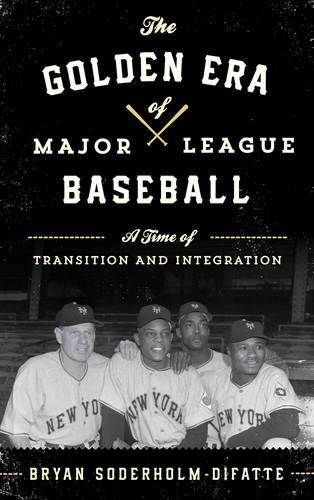
Книга The Golden Era of Major League Baseball: A Time of Transition and Integration
When Jackie Robinson made his debut at Ebbets Field on opening day in 1947, the Brooklyn Dodgers became the first major league team with a black player anywhere in its organization. By the end of the Golden Era of baseball, a period in and around the 1950s, there would be an unprecedented number of notable black players in the major leagues, including Hall of Famers Hank Aaron, Ernie Banks, Roberto Clemente, Willie Mays, and Jackie Robinson. While this era is defined by integration, it was also the age of the “boys of summer” Brooklyn Dodgers, New York Yankee dominance, and the first major change in the geographic landscape of the big leagues in half a century. In The Golden Era of Major League Baseball: A Time of Transition and Integration, Bryan Soderholm-Difatte explores the significant events and momentous changes that took place in baseball from 1947 to 1960. Beginning with Jackie Robinson’s rookie season in 1947, Soderholm-Difatte provides a careful and thorough examination of baseball’s integration, including the struggles of black players who were not elite to break into the starting lineups. In addition, the author looks at the dying practice of player-managers, the increasing use of relief pitchers and platooning, the iconic 1951 pennant race between the New York Giants and the Brooklyn Dodgers, and more. Soderholm-Difatte also tells the stories of three central characters to this era, whose innovations, strategies, and vision changed the game—Branch Rickey, who challenged the baseball establishment by integrating the Dodgers; Casey Stengel, whose 1949-1953 Yankees won five straight championships; and Leo Durocher, whose spy operations was a major factor in the Giants’ 1951 pennant surge. In an age when baseball was at the forefront of American society, integration would come to be the foremost legacy of the Golden Era. But this was also a time of innovative strategy, from the use of pinch hitters to frequent defensive substitutions. Concluding with an overview of how baseball is still evolving today, The Golden Era of Major League Baseball will be of interest to baseball fans and historians as well as to scholars examining the history of integration in sports.
"Soderholm-Difatte, a member of the Society for American Baseball Research and writer of the blog Baseball Historical Insight, draws parallels between America’s growing pains after WWII and baseball’s contemporaneous transformation following a breach in the color barrier. He details the racist history of baseball before Brooklyn Dodgers owner Branch Rickey signed former Negro League star Jackie Robinson in 1947. Rickey’s action sparked a constant stream of black athletes—such as Cleveland’s Larry Doby, and the St. Louis Browns’ Hank Thompson and Willard Brown—fighting for full citizenship against prejudiced white owners and insensitive players in the big leagues. While many owners felt that the Rickey experiment proved fruitful, others didn’t believe Negro League players could perform up to pro standards. Some even produced a scathing antiblack document, the MacPhail Report. Giving a realistic context for this cultural move, Soderholm- Difatte provides a candid, unsettling analysis of the men who brought integration to the clubhouse: Rickey, Leo Durocher, and Bill Veeck, the visionaries looking ahead to the game’s future. With artful prose, this expertly written account on social progress in baseball’s golden age explains how integration changed the sport and America." - Publishers Weekly
"It should come as no surprise that Sodorholm-Difatte, a former CIA analyst and a member of the Society for American Baseball Research (SABR), takes an almost exclusively statistical approach to baseball in the 1950s, often considered the game’s Golden Age. For those who followed baseball through the decade and observed the iconic figures who played or managed then—Robinson, Mays, Mantle, Durocher, Stengel—or even readers who know the era through Roger Kahn’s The Boys of Summer and other anecdote-rich narrative nonfiction, this emphasis on numbers is likely to seem, well, stultifyingly analytical. And yet, the author makes numerous valuable points, if, sometimes, between the numbers. He convincingly demonstrates, for example, that the fifties were a transitional time in such important aspects of play as relief pitching and platooning. He also makes a strong case that while integration fundamentally changed the game in the decade, the less-than-elite African American players did not always fare well. . . . [I]f you’d like to know the numbers behind how they achieved that greatness, this sabermetrician has the goods." - Booklist
"Soderholm-Difatte (a baseball aficionado and regular contributor to baseball publications) offers a fresh approach to a familiar topic, the post-WW II era in Major League Baseball. Instead of focusing on the changes that shaped Major League Baseball, he examines the multiple ways in which the sport evolved in the 15 years following the war. In so doing he allows readers to see how various changes came about as part of a broad spectrum of change within the national pastime. Since the appearance of black players on Major League rosters was the era’s most tangible sign of change, the author bookends his volume with chapters on integration. Other changes include the disappearance of player-managers, the emergence of Casey Stengel, and the geographic shift to cities like Milwaukee and Los Angeles. Written in engaging prose, this interesting book takes readers on a chronological journey through those changes and aptly shows how integration was tough for many to accept long after Jackie Robinson debuted with the Brooklyn Dodgers. Summing Up: Recommended. Lower- and upper-division undergraduates; general readers." - CHOICE
"If you're a scholarly baseball fan, pick up The Golden Era of Major League Baseball by Bryan Soderholm-Difatte." - Good Times Magazine
"Soderholm-Difatte’s offering is a solid example of baseball history that actually places baseball’s first players of color within the context of their white contemporaries. We find out that while Larry Doby was the first black player in the American League, others who were signed shortly thereafter made greater contributions to their respective teams in that ground-breaking 1947 season. Baseball histories detailing tribulations of the first black players in Major League Baseball have been somewhat documented. Soderholm-Difatte provides the successes and travails of these players on the field, in competition with changing dynamics in managerial approaches, as well as changes in how the game itself would be played. . . . Readers . . . will get in-depth contemporary analysis of past players, and a baseball history written through the unique framing of baseball managers." - Sport in American History
"The book is exceptionally readable and will be hard to put down for the hardcore baseball fan.... [I]ts themes will provide rich ground for further research." - Journal of Sport History
"Obviously the most important event during the Golden Era was integration. It changed the landscape of the game and to some degree society as well. When you see these types of books about this era they are mainly focused on segregation. While this one does give segregation its due as a monumental event of the time it also discusses some other events that were taking place in the background of the game. It was a time when baseball was at the forefront of American society and minor things like a change in the on field strategies, the use of a player/manager and the views of pinch hitters were all happening. Relief pitchers were evolving, defensive strategies changed and it was all happening right in front of our eyes, the problem was no one was really noticing. It is a different look at this era than we have seen before and really makes the reader sit up and take notice of what else transpired during one of the most, if not the most important era in the history of the game." - Gregg's Baseball Bookcase