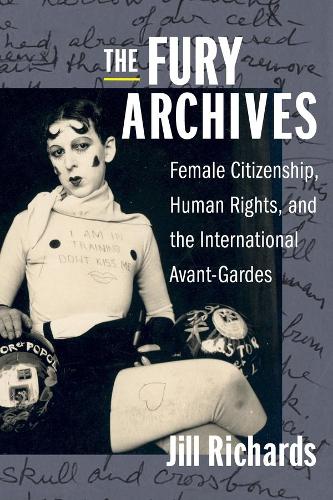
Книга The Fury Archives: Female Citizenship, Human Rights, and the International Avant-Gardes
In the late nineteenth and early twentieth centuries, radical women’s movements and the avant-gardes were often in contact with one another, brought together through the socialist internationals. Juno Jill Richards argues that these movements were not just socially linked but also deeply interconnected. Each offered the other an experimental language that could move beyond the nation-state’s rights of man and citizen, suggesting an alternative conceptual vocabulary for women’s rights.
Rather than focus on the demand for the vote, The Fury Archives turns to the daily practices and social worlds of feminist action. It offers an alternative history of women’s rights, practiced by female arsonists, suffragette rioters, industrial saboteurs, self-named terrorists, lesbian criminals, and queer resistance cells. Richards also examines the criminal proceedings that emerged in the wake of women’s actions, tracing the way that citizen and human emerged as linked categories for women on the fringes of an international campaign for suffrage.
Recovering a transatlantic print archive, Richards brings together a wide range of activists and artists, including Lumina Sophie, Ina Césaire, Rosa Luxemburg, Rebecca West, Angelina Weld Grimké, Elizabeth Gurley Flynn, Hannah Höch, Claude Cahun, Paulette Nardal, and Leonora Carrington. An expansive and methodologically innovative book, The Fury Archives argues that the relationship of women’s rights movements and the avant-gardes offers a radical alternative to liberal discourses of human rights in formation at the same historical moment.
"The range of objects in The Fury Archives is truly impressive, and Richards tackles every object and text that she has excavated for analysis with great skill . . . Richards presents life stories that are not recorded in mainstream history and the unearthing of which creates a more inclusive, accurate, and complete picture of history." - ASAP/Journal
"The sense of this being a history of the present is hard to ignore . . . That strategies such as the occupation of public spaces as an act of protest, strikes to try to accelerate governmental action or the naming of names as an act of acknowledgement and remembrance remain familiar and continue to be employed make many of the decades-old archives seem eerily contemporary." - ArtReview Asia
"Traversing the boundary between the intimate and the public, Richards shows us how to look anew at female citizenship . . . [The Fury Archives] offers important methodological insights to human rights scholars concerned with the field's over-reliance on narrative history." - Human Rights Quarterly
"In addition to rewriting the history of the avant-garde . . . to reveal more complicated entanglements with female citizenship, The Fury Archives offers an energizing model for how we might study feminist activism, sustain ourselves through the long slog of collective action, and intervene in our own here and now." - Signs: Journal of Women in Culture and Society