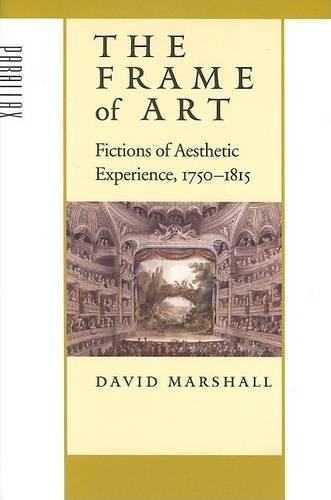
Книга The Frame of Art: Fictions of Aesthetic Experience, 1750–1815
An outstanding work that will instantly be recognized as a major contribution to eighteenth-century literary and artistic studies. Its interpretations are brilliant, its scholarship impeccable. -- Michael Fried, The Johns Hopkins University A brilliant study of how to think about 'aesthetic' experience in a time just beginning to formulate critical questions about the aesthetic. Beyond its magisterial account of history, Marshall's book is an instance of close reading in the best and most advanced sense: Marshall is terrific on detail and finds nuances in individual words and patterns of words because he sees (structurally) how different terms, images, and families of ideas work together. And he is a master of allusion-seeing it and using it himself. His comparative background enables him to move easily among texts whether or not they come from different traditions; he is just as good at comparing texts across genres and modes as among national, cultural, or language traditions. -- J. Paul Hunter, University of Chicago
Aesthetic experience was problematic for Enlightenment authors. Arguing against the commonly held view that aesthetics in the eighteenth and early nineteenth centuries was defined by the professionalization of criticism and the disinterested contemplation and evaluation of the work of art in isolation, David Marshall seeks to understand how and why aesthetic experience in fact often generated tremendous emotion and tension. Focusing on stories about art told in literary, critical, and philosophical writings, in which art is represented as both powerful and disconcerting, he demonstrates how an aesthetic perspective blurs the boundaries between art and reality rather than separating them. Lucid and erudite, The Frame of Art examines an Enlightenment preoccupation with the pervasive presence of art and aesthetic experience in everyday life. Viewing a world composed of images, simulacra, copies, reenactments, performances, paintings, and texts, authors and characters describe and enact-in what Marshall describes as a "representation compulsion"-intense experiences of art that are far from the disinterested museum experience typically seen as the endpoint of eighteenth-century aesthetics. These insightful readings of Charlotte Lennox, Jean-Jacques Rousseau, Gotthold Lessing, Lord Kames, Henry Mackenzie, David Hume, Jane Austen, and the theorists of the picturesque trace the dramatization of aesthetic experience and the desire to design one's life as if it were a work of art-a painting, a play, or a novel. Marshall asks what it means for these authors to view the world through the frame of art.