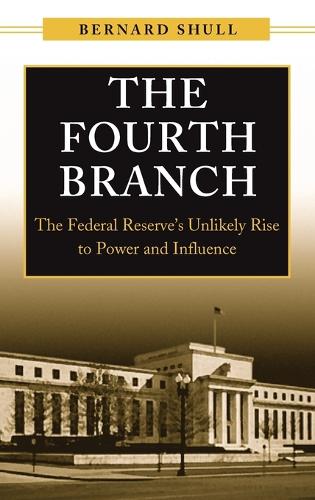
Книга The Fourth Branch: The Federal Reserve's Unlikely Rise to Power and Influence
"Bernard Shull provides unique insights about how the Federal Reserve evolved from 'small and almost impoverished institution' to become a 'bullet proof...colossus.' The key to their success was adaptation to the economic conditions and political realities of the times." -- Benton E. Gup, Ph.D., Chair of Banking, the University of Alabama "Professor Shull's very interesting analysis of how the Federal Reserve rose to power far beyond the intentions of its founders explains an intriguing paradox: that it did so in spite of making huge inflationary and deflationary blunders. This is definitely a good read for anybody interested in the evolution of the American financial system, and a must read for those wishing to understand how useful having a central bank has been and is for the government." -- Alex J. Pollock, Resident Fellow, American Enterprise Institute "The Fourth Branch is a remarkable achievement. Shull has provided an authoritative and clearly written history of the origins of the Fed and of its ability to deal with the three major crises in its 92-year history: the roller coaster of inflation and deflation in the post-World War I years of 1919-1921; the financial and economic implosion of 1929-1933; and the stagflation and subsequent high interest rates of 1973-1982. In each episode, the System made serious errors and received widespread criticism; yet the System emerged each time stronger rather than weaker. Shull attributes this continued strengthening to the adaptability of the System, as well as to its widely recognized value in times of crises (such as wars) and to its unique and flexible structure. This book will be accessible to specialists and generalists alike and is likely to be used as a reference for many decades to come." -- Lawrence J. White, author E. Imperatore Professor of Economics, Stern School of Business, New York University
Shrouded in mystery, managed behind closed doors, and the subject of both awe and derision, the Federal Reserve is commonly referred to as the fourth branch of our federal government, with wide-ranging influence over monetary policy, and by extension, banking, price levels, employment rates, and economic growth, income, and wealth. Bernard Shull traces the fascinating and improbable history of this institution from its establishment by an Act of Congress in 1913 to the present day. His careful analysis reveals a paradoxical phenomenon: focusing on three periods of economic stress (the inflation and deflation following World War I, the stock market crash of 1929 and subsequent Depression, and the stagflation and volatility of the 1970s and 1980s), Shull argues that despite convincing evidence that the Fed contributed to these crises, it has consistently emerged from each more powerful and influential than before. Setting the current profile of the Fed against its evolutionary context, The Fourth Branch sheds new light on the Fed's character and its impact on our economic, political, and cultural history.
In many ways, the story of the Fed is the classic American epic: turning adversity into opportunity, responding to threat by innovating and adapting. Even today, under attack by liberals and conservatives alike—in the wake of the stock market bubble, economic recession, and rampant job loss—the Fed is poised to remain strong long after the tenure of legendary Chairman Alan Greenspan. Setting the current profile of the Fed against its evolutionary context, The Fourth Branch sheds new light on the Fed's character and its impact on our economic, political, and cultural history.