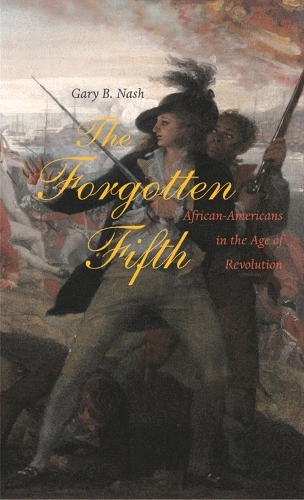
Книга The Forgotten Fifth: African Americans in the Age of Revolution
As the United States gained independence, a full fifth of the country's population was African American. The experiences of these men and women have been largely ignored in the accounts of the colonies' glorious quest for freedom. In this compact volume, Gary B. Nash reorients our understanding of early America, and reveals the perilous choices of the founding fathers that shaped the nation's future.
Nash tells of revolutionary fervor arousing a struggle for freedom that spiraled into the largest slave rebellion in American history, as blacks fled servitude to fight for the British, who promised freedom in exchange for military service. The Revolutionary Army never matched the British offer, and most histories of the period have ignored this remarkable story. The conventional wisdom says that abolition was impossible in the fragile new republic. Nash, however, argues that an unusual convergence of factors immediately after the war created a unique opportunity to dismantle slavery. The founding fathers' failure to commit to freedom led to the waning of abolitionism just as it had reached its peak. In the opening decades of the nineteenth century, as Nash demonstrates, their decision enabled the ideology of white supremacy to take root, and with it the beginnings of an irreparable national fissure. The moral failure of the Revolution was paid for in the 1860s with the lives of the 600,000 Americans killed in the Civil War.
The Forgotten Fifth is a powerful story of the nation's multiple, and painful, paths to freedom.
"Nash's reminder that African-Americans made up a fifth of the population during the Revolutionary era exemplifies the purpose of this lively, accessible 'corrective to historical amnesia,' comprising three discrete chapters based on lectures he delivered at Harvard in 2004. The wide-ranging first chapter, 'The Black Americans' Revolution,' illustrates how the War for Independence whetted slaves' thirst for freedom. Nash chronicles slave defection to the British (for whom many more blacks fought than for the Americans) and sketches vivid portraits of individuals who sued for their freedom in the courts. The impassioned second chapter asks, 'Could Slavery Have Been Abolished?' and argues the affirmative--that ending slavery during the postrevolutionary period was not only possible but would have unified rather than split the nation. Nash traces broad political and economic conditions (e.g., widespread abolitionist sentiment) to support his argument, and blames the nation's leaders and founding fathers for their lack of political courage. The concluding essay explores questions of citizenship and national identity through the early 19th-century writings of two contemporary Philadelphians, the African-American businessman James Forten and Tench Coxe, a white political economist. Nash exhibits gracefully assertive scholarship in this brief but meaty synthesis." - Publishers Weekly
"During the American Revolution, one in every five Americans was black. The British offered freedom in return for joining the fight against the rebels. The Continental Army did not. In a slim but well-researched narrative, historian Nash questions the idea that slavery was an issue best deferred in the early days of the Republic." - USA Today
"A book to stimulate robust debate, this one is well worth the read." - American Historical Review
"This short book features three provocative essays based on the author's 2004 Nathan Huggins Lectures at Harvard. In characteristic style, Nash challenges historical assumptions about African Americans during the revolutionary period...Well researched, engaging, and thought-provoking." - Library Journal
"Gary Nash shows that the African slaves hardly stood by impassively as Revolution approached and that at least part of their plight when their fate was considered at the Constitutional Convention in 1787 was that so many of them had made a daring political choice--but a disastrous one as it turned out...Nash illuminates a largely overlooked chapter in black history, the flight of thousands of slaves to the side of the British during the War for Independence...Required reading for anyone who ponders the impact of slavery on our lives today." - Washington Times
"Thoughtful...The modest but forceful reassessment by Nash...evoke[s] colonial and post-colonial greed as fully as the arbitrary and unforgiving boundaries on the map of contemporary Africa. No matter which side won in America, the black population lost." - Washington Post Book World
"Historians have generally assumed that the postwar flurry of antislavery sentiment and action was superficial and doomed to failure. Nash boldly suggests otherwise, arguing that the movement came very close to success and failed only because of a lack of astute and effective leadership on the part of those who were in a position to make a difference, namely the Founding Fathers...Nash's argument is original and suggestive." - New York Review of Books
"The Revolutionary generation in America did not end slavery—that is a fact...Moreover, enslaved black Americans were not idle bystanders; they launched a resistance movement, which the author claims identifies them as black founding fathers. But this is not the lesson school children learn; they are taught what the slaveholding minority believed: that ending slavery meant disunion. This is the story eloquently told by Gary B. Nash in this book. Nash does not intend to “destabilize history”; rather, he wants to portray a more diverse picture of the United States (vii)...This skillful historian provides many examples of how African-Americans and their supporters engaged the fight for liberty to include all the people...His elegant prose makes the book accessible virtually to anyone interested in historical literature." - The Historian