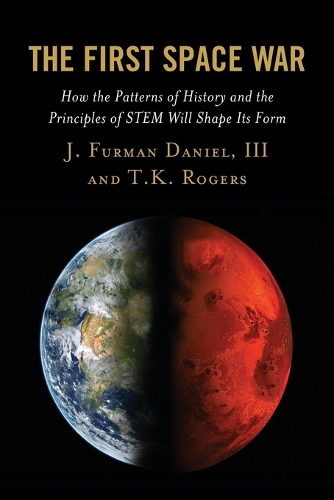
Книга The First Space War: How the Patterns of History and the Principles of STEM Will Shape Its Form
Unfortunately, much of what people believe about war in space has been shaped, or misshaped, by Hollywood and other forms of popular media. In this book a STEM educator and a political science professor team up to explore the possibilities for warfare in space and explain why almost everything you've learned about space wars from movies is disappointingly wrong. The truth is stranger and more interesting than fiction. Using history, politics and STEM as guides, this book provides a detailed account of how Earth’s first war in space will be fought. As we show, it will begin not as an invasion of Earth by super-advanced aliens but by Earth starting a war with its Martian colony.
"
The premise of this work is a hypothetical story set approximately 250 years in the future, following a robust human colonization of Mars. The authors present a fictionalized account based on past history and current scientific trends. The early chapters present the historical reasons for colonization (citing the Spanish and British interests of the 16th and 17th centuries), including the acquisition of energy, materials, information, and territory. The physical realities of living on Mars (reduced gravity, carbon dioxide atmosphere, and increased radiation) are then imaginatively presented, further projecting how putatively successful efforts at "terraforming" Mars would make it suitable for human habitation. The fable also considers the hypothetical outcome of humans being born on Mars, and the consequent development of a Martian culture that differs from the one found on Earth. The authors argue that Martian and Earth interests will inevitably diverge, which will lead to eventual conflict. The historical conflict between the American Colonies and the British is frequently cited as the reference model. The authors finally discuss the detailed mechanics and outcome of the projected war, including a hypothetical negotiated settlement. This book provides a fascinating and interesting perspective on human colonization of Mars, with a possible scenario for the near future. Summing Up: Highly recommended. All readers.
" - Choice Reviews