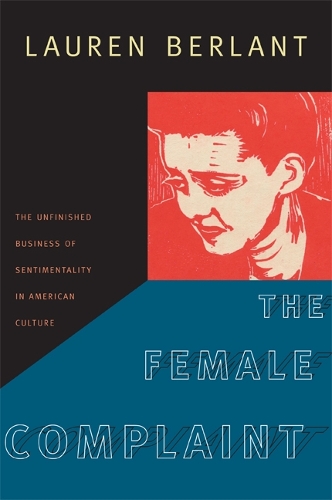
Книга The Female Complaint: The Unfinished Business of Sentimentality in American Culture
Considers the development of sentimental "women's culture" in the U.S. - from Uncle Tom's Cabin to 1950s melodrama to contemporary chick lit
The Female Complaint is part of Lauren Berlant’s groundbreaking “national sentimentality” project charting the emergence of the U.S. political sphere as an affective space of attachment and identification. In this book, Berlant chronicles the origins and conventions of the first mass-cultural “intimate public” in the United States, a “women’s culture” distinguished by a view that women inevitably have something in common and are in need of a conversation that feels intimate and revelatory. As Berlant explains, “women’s” books, films, and television shows enact a fantasy that a woman’s life is not just her own, but an experience understood by other women, no matter how dissimilar they are. The commodified genres of intimacy, such as “chick lit,” circulate among strangers, enabling insider self-help talk to flourish in an intimate public. Sentimentality and complaint are central to this commercial convention of critique; their relation to the political realm is ambivalent, as politics seems both to threaten sentimental values and to provide certain opportunities for their extension.
Pairing literary criticism and historical analysis, Berlant explores the territory of this intimate public sphere through close readings of U.S. women’s literary works and their stage and film adaptations. Her interpretation of Uncle Tom’s Cabin and its literary descendants reaches from Harriet Beecher Stowe to Toni Morrison’s Beloved, touching on Shirley Temple, James Baldwin, and The Bridges of Madison County along the way. Berlant illuminates different permutations of the women’s intimate public through her readings of Edna Ferber’s Show Boat; Fannie Hurst’s Imitation of Life; Olive Higgins Prouty’s feminist melodrama Now, Voyager; Dorothy Parker’s poetry, prose, and Academy Award–winning screenplay for A Star Is Born; the Fay Weldon novel and Roseanne Barr film The Life and Loves of a She-Devil; and the queer, avant-garde film Showboat 1988–The Remake. The Female Complaint is a major contribution from a leading Americanist.
"The essays take as a beginning the 'women's culture' of the eighteen-thirties, which, Berlant argues, was the U.S.’s first 'intimate public,' a mass-market culture premised upon a shared emotional world among its consumers. They go on to consider novels, films, musicals, and cultural moments whose emotional excesses reinforce an attachment to the suffocating conditions of an all-American fantasy: Uncle Tom’s Cabin, Show Boat, John Stahl’s film Imitation of Life, the memorialized deaths of Princess Diana and J.F.K., Jr. . . . Sentimentality isn’t finished with us yet, though may its fantasies be met not with finger-wagging—a favored sentimental mode!—but sustained analysis. Now is the summer of our female complaint! Which, if you have the fortune of being a woman, is every summer." - The New Yorker
"“The Female Complaint advances and refines the relationship between intimacy and publicity in ways that suggestively rethink the category of individuality in late capitalism. . . . The Female Complaint is an uncannily hopeful book, finding value and possibility in a wholly nonredemptive account of convention.”
" - GLQ
"“The Female Complaint is a tour de force, a bracing read for feminist and postmodernist students of popular culture, as well as for genre theorists.”" - Journal of Popular Culture
"“Some of the most important essays on U.S. culture produced during the past decade appear in The Female Complaint.”" - Novel
"“The affective pleasure of reading The Female Complaint emerges from its unwillingness to sacrifice either incisive political critique that challenges the limits of women’s culture or textured formal accounts of the powerful emotional experience its texts provide for its consumers. . . . Theoretically ambitious and cogently argued, funny and invigorating, Berlant’s text promises to profoundly reshape how we think about sentimentality, gender, and affect in American culture.”" - American Book Review