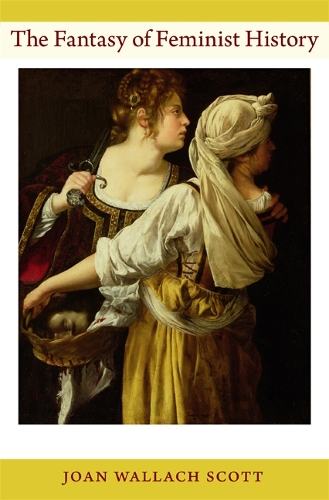
Книга The Fantasy of Feminist History
Eminent feminist historian Joan Scott gives an argument for the use of fantasy and psychoanalysis in feminist history. Like many historians, Scott once thought of psychoanalysis as too ahistorical. More recently she has come to see that if 'woman' or 'gender' are social categories that shift historically, that requires concepts of fantasy, contradiction and desire that are the domain of psychoanalysis. Without that, there would be no basis for collective desires for social change.
In The Fantasy of Feminist History, Joan Wallach Scott argues that feminist perspectives on history are enriched by psychoanalytic concepts, particularly fantasy. Tracing the evolution of her thinking about gender over the course of her career, the pioneering historian explains how her search for ways to more forcefully insist on gender as mutable rather than fixed or stable led her to psychoanalytic theory, which posits sexual difference as an insoluble dilemma. Scott suggests that it is the futile struggle to hold meaning in place that makes gender such an interesting historical object, an object that includes not only regimes of truth about sex and sexuality but also fantasies and transgressions that refuse to be regulated or categorized. Fantasy undermines any notion of psychic immutability or fixed identity, infuses rational motives with desire, and contributes to the actions and events that come to be narrated as history. Questioning the standard parameters of historiography and feminist politics, Scott advocates fantasy as a useful, even necessary, concept for feminist historical analysis.
"“The Fantasy of Feminist History remains a fascinating and timely engagement with important questions concerning the rhetoric and ideology of historical representation, and it will undoubtedly have broad appeal for scholars working in and across a range of disciplines and fields of study, including history, gender studies, critical theory, cultural studies, psychoanalysis, and postcolonialism. Scott is particularly adept at rendering complex theoretical concepts in eminently clear, readable terms, as well as at providing concise genealogies of the institutional, intellectual, and social contexts in which those concepts were initially developed and have been put to use subsequently.”" - Reviews in Cultural Theory
"“This is a provocative volume and will be of particular interest to those seeking a bridge between sociology’s measurable quantities and psychology’s emphasis on the unknowable. With connections to an array of disciplines including history, women’s studies, literary theory, and psychology, it holds promise for broad reach across the academy.”" - On Campus with Women
"“Against Scott’s formulation, historians may continue to assert that there is little empirical foundation for psychoanalytic concepts of fantasy, although it is difficult to argue that the histories she discusses are not informed by emotional investments that cannot be explained ideologically or empirically. The epilogue, which reminds us that archives are a repository of passion as well as information, should give all historians a reason to examine the scenes into which they may have written themselves.”" - Journal of Modern History
"“Scott’s undertaking should be commended for its daring attempt to tease out new ways of analysing historical material.”" - European Review of History
"The importance of Scott's book lies in its refusal of a damaging spatial binary of surface and depth. Surface readers accuse ‘depth’ readers of not being aware of their own fantasies as readers, in turn, they are agnostic about knowing such entanglements in their surface readings. It is precisely the entanglements of the reader and text and the fantasies of historical knowledge that Scott engages. Her critical reading practice insists not only on close reading of the text, but also close reading of the reader herself.” - Journal of Social History
"“The impressive yield of this anthology is that it deals with supposedly familiar subjects but still succeeds in opening up a new discussion. . . . Scott delivers interesting discussions over many theoretical concepts, and her diagnosis, with the help of psychoanalysis, of the discipline’s shortcomings is striking.”" - History and Theory
"“I choose to conclude by mentioning one aspect that I consider of special relevance: the critique of the fantasy of continuity in historical constructions. This critique concerns not only the temporal categories of history and its periodisation, but is tightly linked with the critique of essentialism. This is why I consider it foundational for any innovative historical practice, including the multifarious forms of feminist history."" - Gender & History
"“The Fantasy of Feminist History deal with one of the oldest and most difficult problems faced by feminist historians across the generations: how is it possible to account for emotions, passions, feelings, desires and fantasies while doing historical research? It is easy to predict that the arguments – and the book – will play a central role in theoretical and methodological debates among scholars working on gender issues in years to come.” " - European Journal of Women's Studies