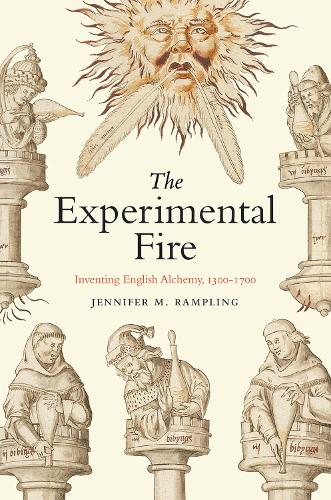
Книга The Experimental Fire: Inventing English Alchemy, 1300–1700
A 400-year history of the development of alchemy in England that brings to light the evolution of the practice.
In medieval and early modern Europe, the practice of alchemy promised extraordinary physical transformations. Who would not be amazed to see base metals turned into silver and gold, hard iron into soft water, and deadly poison into elixirs that could heal the human body? To defend such claims, alchemists turned to the past, scouring ancient books for evidence of a lost alchemical heritage and seeking to translate their secret language and obscure imagery into replicable, practical effects.
Tracing the development of alchemy in England over four hundred years, from the beginning of the fourteenth century to the end of the seventeenth, Jennifer M. Rampling illuminates the role of alchemical reading and experimental practice in the broader context of national and scientific history. Using new manuscript sources, she shows how practitioners like George Ripley, John Dee, and Edward Kelley, as well as many previously unknown alchemists, devised new practical approaches to alchemy while seeking the support of English monarchs. By reconstructing their alchemical ideas, practices, and disputes, Rampling reveals how English alchemy was continually reinvented over the space of four centuries, resulting in changes to the science itself. In so doing, The Experimental Fire bridges the intellectual history of chemistry and the wider worlds of early modern patronage, medicine, and science.
"The Experimental Fire reads like an insider's history of English alchemy, exposing its inner workings and demystifying its encrypted canon with adeptness and hard-earned authority. Jennifer M. Rampling meets the frustrating material of alchemical history with all the scholarly agility and suspicion requisite to the task. This book steers straight into the hazards of alchemical literature, with its bricolage texts full of borrowed works uncited or cited badly, recorded in manuscripts annotated by many anonymous hands. Rampling is the first to handle these hazardous materials so comprehensively and confidently. She reports on her many archival discoveries and assembles them into a coherent narrative of influence and innovation in English alchemy over four centuries. Her forerunner in this strange country was Dorothea Waley Singer, whose preliminary census of alchemical manuscripts in British libraries laid the groundwork for English alchemical history and has awaited a proper follow-up since 1931. With Experimental Fire, Rampling delivers one." - Los Angeles Review of Books
"This is a densely argued academic work which builds its case for a particular view of English alchemy example by example, with a crop of detailed footnotes sprouting from the base of every page. . . . [As] an introduction to the evolution of English alchemy, it is impeccable." - Fortean Times
"An engaging piece of scholarly work that should satisfy the expert and the layman alike. It makes a subject like alchemy, that appears highly abstruse, palatable to readers who may balk at the complexity and remoteness of alchemical language. More than anything, perhaps, it humanises the alchemist, showing him or her to be a historical personage caught up in the circumstances of the era and seeking to survive the upheavals and challenges of historical reality. As such, Rampling's book is not just an essential read for the new historiography of alchemy, but it is bound to make an important contribution to the history of science, social history, history of scholarship, and the history of the book." - Early Science and Medicine
"Jennifer M. Rampling’s first book takes on the incredible feat of identifying and tracing a specific strand of sericonian alchemical knowledge across a 400-year period. . . . In this book, Rampling expertly unpacks the function of English alchemical authority and patronage within a pan-European network of practitioners. She has pieced together a compelling narrative of national identity and alchemical change over time. . . . this will be a necessary addition to the bookshelves of any scholar of alchemy, patronage, the book, and English intellectual history." - Isis
"Rich and vast. . . . The Experimental Fire challenges us to grapple with a more expansive idea of history, one that includes the lineage, development, and comprehension of false knowledge. Just because something isn’t true doesn’t mean it’s not real, that it can’t be studied, argued over, or taught. Indeed, alchemy, Rampling argues, is nothing but the invention and reinvention of one type of knowledge. And what is literature, or history, or science, if not a variation of the same?" - Chicago Review of Books
"A new and fascinating angle on how alchemy began to transform science into a modern enterprise. . . . Beautifully and clearly written." - Forbidden Histories
"“In The Experimental Fire: Inventing English Alchemy, 1300-1700, Jennifer M. Rampling presents the largely uncharted history of English alchemy from its medieval roots until the end of the seventeenth century with an astounding eye for detail.”" - Annals of Science
"Rampling's extensive survey of English alchemy is a masterclass in history of science research and serves as a model for anyone who wishes to undertake such a project. Although it meets the highest standards of academic research, she writes with a light touch and an accomplished literary style making a complex and technical topic accessible to the not necessarily specialist reader. . . . Anybody with some basic knowledge of the history of alchemy, and an interest in developing that knowledge, could and should read her book. For those with a serious interest in the topic The Experimental Fire is an obligatory read and must already be considered a standard work in the genre." - Renaissance Mathematicus
"Rampling's book is a rich source for a reader interested in English alchemy in the late medieval and early modern period. Rampling deserves praise for bringing to light a large amount of as yet unpublished manuscripts, which are analysed in detail as well as placed in their historical, social, and religious contexts. The picture that emerges from this book is one of a complex network, in which practitioners, patrons, physicians, collectors, and forgers interacted and influenced each other and the art of alchemy." - Journal of Early Modern Studies
"Captivating. . . . Whether your interest is in early modern European history, the history of science, or old occult practices, this is a book well worth giving consideration as your next reading selection." - Well-read Naturalist
"As Rampling analyzes how the English alchemical practitioners filled gaps in information found in their books and resolved discrepancies between texts and experience, she identifies networks of readers and traces a subtle evolution in how works on alchemy were read. She notes parallels in these reading practices with developments in other forms of knowledge, such as Reformation-era theology. This book is well organized, offers readable and engaging prose, and has been carefully edited. The bibliography and index are comprehensive. . . . Highly recommended." - Choice
"In The Experimental Fire: Inventing English Alchemy, 1300–1700, Jennifer Rampling traces this sericonian branch of alchemy through its highs and lows from the medieval to the early modern periods, emphasizing that alchemy was not a homogenous or static discipline but rather one that underwent a series of subtle yet important changes." - Journal of British Studies