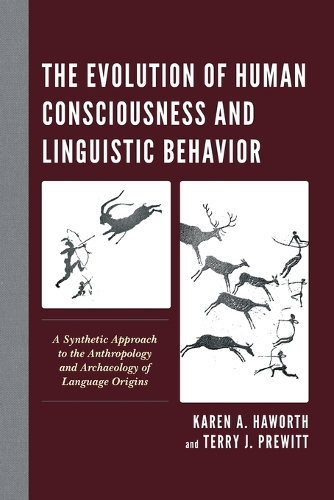
Книга The Evolution of Human Consciousness and Linguistic Behavior: A Synthetic Approach to the Anthropology and Archaeology of Language Origins
Drawing from the disciplines of cognitive science, Paleolithic anthropology, art history, and semiotics, Karen A. Haworth and Terry J. Prewitt offer a novel discussion of the origins of language, based primarily in the distinction of holistic versus analytical cognitive processing. Also, by employing a refined view of human symboling capacities grounded in the writings of C. S. Peirce, they provide a short but comprehensive explanation of what the artifacts and art of the Paleolithic and Mesolithic periods suggest about language origins. Their interpretation supports a semiotic argument that “iconic and indexical logical modeling” precedes human elaboration of experience by symbolic reference in words or propositions, and ultimately in what Peirce called “the argument.” Further, they suggest that the use of symbols to model the world developed rapidly between about 20,000 and 10,000 years ago, and has the effect of giving emphasis to analytic thought as the dominant mode of human consciousness. Rather than seeing symbols as the impetus for human logic, they argue for presymbolic elements of logic in Peirce’s sign categories shared widely by humans and other animals.
Intended readers are scholars in philosophy, anthropology, psychology, linguistics, and semiotics, as well as interested nonspecialists. The presentation is also complemented with brief personal narratives, intended to offer background that helps make a dense academic argument more accessible to the widest audience possible. The authors’ insights into the basis for language have ramifications for any number of other fields: education, psychology, philosophy, prehistory, and art, to name a few.
"
This is a volume that cannot be readily classified, one which promises a "synthetic approach" that bridges multiple disciplines to address perennial questions regarding the co-origins of human language and consciousness. In treating these issues across disciplines, Haworth and Prewitt endeavor to strike a balance between general language and specialized terminology. . . is the personal narrative that introduces each chapter, which describes their own evolution as academics, thinkers, and practitioners. While the purported aims may be lofty—for the analytical conclusions "to relate back ... to the human condition as it unfolds"—the effect of "such 'messy' texts" is to situate the narrator/author/ethnographer as one participant among many, coming to an understanding in a linear sequence that they are sharing with their readers. This may have the effect of making the text more legible to the non-specialist. . . Overall, this is a compact treatment of a complex subject, rendered in accessible, non-technical language, suitable for advanced students and scholars. Summing Up: Recommended. Advanced undergraduates through faculty; professionals.
" - Choice