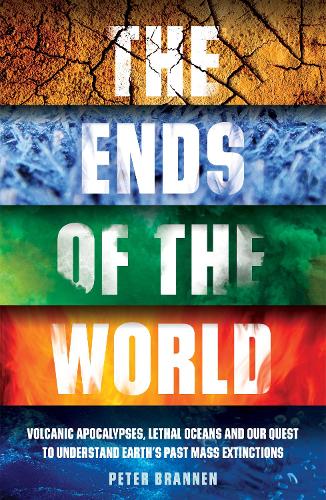
Five times our world has stood on the brink of Armageddon – it’s been incinerated, frozen, drained, flooded and smothered by poison gas. We are very lucky to be alive...
‘A book about one apocalypse – much less five – could have been a daunting read, were it not for the wit, lyricism, and clarity that Peter Brannen brings to every page.’ Ed Yong, author of I Contain Multitudes
Apocalypse, now?
Death by fire, ice, poison gas, suffocation, asteroid. At five moments through history life on Earth was dragged to the very edge of extinction.
Now, armed with revolutionary technology, scientists are uncovering clues about what caused these catastrophes. Deep-diving into past worlds of dragonflies the size of seagulls and fishes with guillotines for mouths, they explore how – against all the odds – life survived and what these ominous chapters can tell us about our future.
"
'His evocative prose brings the “incomprehensible eternities” of ancient history vividly alive…A remarkable journey into the deep past that has much to teach us about the future of our planet.'
" -
Guardian"
‘Gripping… Brannen excels at evoking lost worlds.’
" -
The New Yorker"
‘Fascinating.’
" -
The Economist"
‘[Brannen] is a companionable guide, as good at breathing life into the fossilized prose of scientific papers as he is at conjuring the Ordovician reign of the nautiloids.’
" -
New York Times Book Review"
‘If readers have time for only one book on the subject, this wonderfully written, well-balanced, and intricately researched (though not too dense) selection is the one to choose.’
" -
Library Journal, starred review
"
‘Fascinating.’
" -
Geographical Magazine"
‘Much-needed as a cautionary lesson and a hopeful demonstration of how life on Earth keeps rebounding from destruction.’
" -
Booklist"
'A simultaneously enlightening and cautionary tale of the deep history of our planet and the possible future, when conscious life may become extinct…. Entertaining and informative on the geological record and the researchers who study it. [Brannen] provides a useful addition to the popular literature on climate change.'
" - Kirkus Reviews