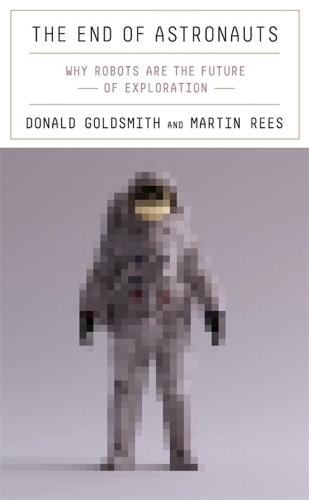
Книга The End of Astronauts: Why Robots Are the Future of Exploration
A History Today Book of the Year
A world-renowned astronomer and an esteemed science writer make the provocative argument for space exploration without astronauts.
Human journeys into space fill us with wonder. But the thrill of space travel for astronauts comes at enormous expense and is fraught with peril. As our robot explorers grow more competent, governments and corporations must ask, does our desire to send astronauts to the Moon and Mars justify the cost and danger? Donald Goldsmith and Martin Rees believe that beyond low-Earth orbit, space exploration should proceed without humans.
In The End of Astronauts, Goldsmith and Rees weigh the benefits and risks of human exploration across the solar system. In space humans require air, food, and water, along with protection from potentially deadly radiation and high-energy particles, at a cost of more than ten times that of robotic exploration. Meanwhile, automated explorers have demonstrated the ability to investigate planetary surfaces efficiently and effectively, operating autonomously or under direction from Earth. Although Goldsmith and Rees are alert to the limits of artificial intelligence, they know that our robots steadily improve, while our bodies do not. Today a robot cannot equal a geologist’s expertise, but by the time we land a geologist on Mars, this advantage will diminish significantly.
Decades of research and experience, together with interviews with scientific authorities and former astronauts, offer convincing arguments that robots represent the future of space exploration. The End of Astronauts also examines how spacefaring AI might be regulated as corporations race to privatize the stars. We may eventually decide that humans belong in space despite the dangers and expense, but their paths will follow routes set by robots.
"A delightfully lucid and succinct manifesto for reforming science policy…Evidently passionate in their conviction that robots should be the ones to boldly go where no man (or woman) has gone before, they present their case soberly and systematically, carefully evaluating counterarguments." - Literary Review
"Informs us about the full cost of human space exploration and how AI and robotic missions deserve their place in this story. It’s a terrific read and an invaluable reference in the debate of human versus robotic spaceflight." - BBC Sky at Night
"Explain[s] why we should give up on manned space exploration…For anyone seriously interested in space exploration, this slaughter of impractical ideas in The End of Astronauts will be welcome." - The Times
"Argue[s] that, given the vast distances and the dangers involved in space travel, it is robots, not humans, that will lead us to the stars." - New Scientist
"Make[s] a convincing case that blasting humans into space has become a wasteful indulgence. Far more can be accomplished by robotic missions of scientific discovery." - Financial Times
"Thought-provoking…Goldsmith and Rees make a compelling case for robotics over astronauts." - Forbes
"In this refreshingly no-nonsense brief, [Goldsmith and Rees] take a sharp-focused look at the hyperbolic aspirations of space enthusiasts who promote colonies on the Moon and Mars as the next great step for mankind…In the half century since the last footprint on the Moon, humans haven’t boldly gone any further, while robot explorers have been very busy." - Natural History
"A provocative primer on the future of space travel." - Publishers Weekly
"A readable and useful contribution to this longstanding debate." - Wall Street Journal
"[A] thought-provoking vision of the coming decades in space exploration." - Physics World
"One big advantage of crewed space missions is the human intelligence embodied by the astronauts—but does this benefit outweigh the costs? How far are robots from catching up to human capabilities in space? These are the sorts of questions that astrophysicists Donald Goldsmith and Martin Rees ask in The End of Astronauts, examining the pros and cons of proposals for human exploration in the Solar System." - Nature Astronomy
"What is so interesting about this book is how it constructs or deconstructs, depending on your view, the evidence for continuing the process of sending astronauts into space…It is exceptionally well written and cleverly split into well thought out chapters. It most importantly provides evidence without siding one way or the other." - Physics Education
"A provoking argument for space exploration sans astronauts…A tour de force of well-written, compelling rationales. The authors believe that beyond low-Earth orbit, space exploration should proceed without humans." - Inside Outer Space
"Imagines a future where frugal humans can have their cosmic cake and eat it too—as long as they don't mind robot bakers…The book's main argument is convincing. Robots offer more bang for the buck, not just because they cost less but also because they can do a lot. If, eventually, robots are able to do nearly everything astronauts currently can, sending people into space may well become pure vanity." - Reason