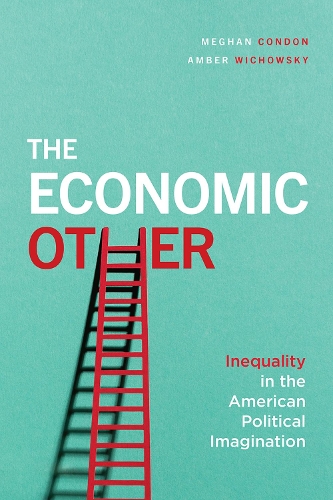
Книга The Economic Other: Inequality in the American Political Imagination
Economic inequality is at a record high in the United States, but public demand for redistribution is not rising with it. Meghan Condon and Amber Wichowsky show that this paradox and other mysteries about class and US politics can be solved through a focus on social comparison. Powerful currents compete to propel attention up or down--toward the rich or the poor--pulling politics along in the wake. Through an astute blend of experiments, surveys, and descriptions people offer in their own words, The Economic Other reveals that when less-advantaged Americans compare with the rich, they become more accurate about their own status and want more from government. But American society is structured to prevent upward comparison. In an increasingly divided, anxious nation, opportunities to interact with the country's richest are shrinking, and people prefer to compare to those below to feel secure. Even when comparison with the rich does occur, many lose confidence in their power to effect change. Laying bare how social comparisons drive political attitudes, The Economic Other is an essential look at the stubborn plight of inequality and the measures needed to solve it.
"While, as the authors argue, to compare is human, a lot goes into which comparisons we make. Whether individuals engage in upward or downward comparison makes a huge difference in how they construct inequality in their minds and their political responses to this inequality. Condon and Wichowsky argue that which comparisons individuals choose to engage in, and which ones they are encouraged to make by the media and the political machinery determines how they react. Their ability to connect the dots between economic trends, social psychology, and politics of identity construction create an engaging book with tremendous salience for the present political moment." - Population and Development Review
"[The Economic Other] explores the central role of social comparison in the politics of inequality, focusing on ways that race and gender determine the nature and impact of cross-class comparisons. . . . [The book] investigates why Americans have not demanded more economic redistribution despite the substantial increases in income inequality. . . . [and] evaluates whether these reinforcing patterns regarding social comparison can be interrupted." - Journal of Economic Literature
"“This book offers a wide range of insights and valuable causal inferences, serves as a methodological model that will likely be referenced in the future, and is sufficiently theoretically overabundant that scholars and students will likely be reading and building on it for many years to come.”" - Perspectives on Politics
"Scholars of race, ethnicity, and politics will value the book’s detailed examination of heterogeneity across races and genders." - Journal of Race, Ethnicity, and Politics
"A timely and necessary piece of scholarship, this book contributes to a rich literature about inequality and the hesitancy to redistribute, opening up many possibilities for future research... This book should be required reading for not only academics, but anyone who wishes to better understand inequality in the United States." - Political Science Quarterly
"Condon and Wichowsky add a crucial social-psychological dimension to existing understandings of the roots of American attitudes about economic inequality, and contribute fresh insights on the obstacles that confront political efforts to mitigate inequality. This is a book I recommend highly to public opinion scholars for its theoretical insight and astute methodological blend. But it also deserves to be read widely by scholars interested in how political messages, policy proposals, and institutional reforms can undermine or encourage constructive responses to our economic divide." - Public Opinion Quarterly