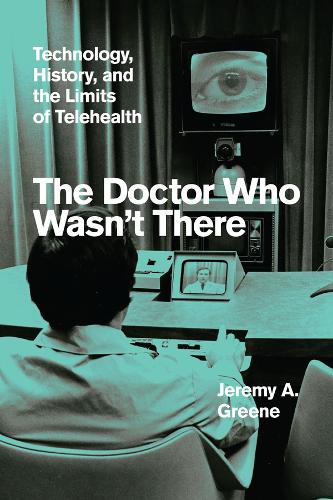
Книга The Doctor Who Wasn't There: Technology, History, and the Limits of Telehealth
This gripping history shows how the electronic devices we use to access care influence the kind of care we receive.
The Doctor Who Wasn’t There traces the long arc of enthusiasm for—and skepticism of—electronic media in health and medicine. Over the past century, a series of new technologies promised to democratize access to healthcare. From the humble telephone to the connected smartphone, from FM radio to wireless wearables, from cable television to the “electronic brains” of networked mainframe computers: each new platform has promised a radical reformation of the healthcare landscape. With equal attention to the history of technology, the history of medicine, and the politics and economies of American healthcare, physician and historian Jeremy A. Greene explores the role that electronic media play, for better and for worse, in the past, present, and future of our health.
Today’s telehealth devices are far more sophisticated than the hook-and-ringer telephones of the 1920s, the radios that broadcasted health data in the 1940s, the closed-circuit televisions that enabled telemedicine in the 1950s, or the online systems that created electronic medical records in the 1960s. But the ethical, economic, and logistical concerns they raise are prefigured in the past, as are the gaps between what was promised and what was delivered. Each of these platforms also produced subtle transformations in health and healthcare that we have learned to forget, displaced by promises of ever newer forms of communication that took their place.
Illuminating the social and technical contexts in which electronic medicine has been conceived and put into practice, Greene’s history shows the urgent stakes, then and now, for those who would seek in new media the means to build a more equitable future for American healthcare.
"A fascinating story of the hype, achievements, and inevitable shortcomings of telehealth technology. . . . As Greene shows, science and technology alone will never be able to deliver a more just and equitable society." - Science
"This is one of Greene’s recurring themes: the greatest enthusiasm for novel medical technologies was often on the side of those who stood to gain financially from their widespread adoption. Doctors, among the supposed beneficiaries, were usually more gimlet-eyed, not only about the extra demands this new technology might place on them, but also about how it might interfere with the doctor–patient relationship." - Inside Story
"Greene's new book chronicles the evolution of telemedicine. He makes the case that at various stages along the way of that evolution, telemedicine was seen as a panacea that was going to expand access and diminish disparities in the delivery of health care, but those promises remain promises largely unfulfilled." - WYPR's Midday
"Early in the COVID-19 pandemic, physician Greene converted his clinic to telemedicine, with mixed results. He became curious about the medical history of communications technology such as the telephone, invented in 1876. The 1910 'telephonic stethoscope' was hailed for monitoring hearts, lungs and abdomens. Yet it was no use to the numerous patients who lacked a telephone even decades later. This vibrant, highly readable, but US-focused history describes how many other technologies tried 'to democratize access to healthcare.'" - Nature
"This volume offers a decades-long professional investigation of telemedicine, lately a victim of opportunistic post-COVID-19 lockdown days. Greene provides an enlightening, vivacious text written in an authoritative, fact-driven tone. The first chapter crushes the myth of electronic telemedicine as a twenty-first-century phenomenon, tracing its origins to the expansion of the telephone in the 1880s. Greene's overview of the procession of hype, gadgets, and prognostications about the death of the doctor-patient relationship that accompanied the introduction of Bell's invention establishes the historical pattern still followed by consumer (and sometimes military) remote technologies when retooled for medicine. From there, supported by coeval photographs that help rekindle the historical atmosphere, Greene guides readers through the birth of non-invasive—thus telemedical—diagnostic tools, the ever-present beeper, and closed-circuit television. The book next offers a definitive portrait of the endeavors of computer-based information and automation technologies in contemporary medicine, perhaps more familiar to today's readers. Greene concludes with insightful final reflections. Maybe groundbreaking innovations are always misunderstood in their own times, but the doomsday prophets' dystopian predictions dissipate as promises materialize and become familiar. The past in telemedicine naturally becomes the grotesque image of the present: this is the main lesson of Greene's text. Recommended." - Choice
"Greene crafts a brilliant history of modern American telehealth from case studies of the medical uses of telephones, televisions, and computers, the wireless heart monitor, the beeper, digitalization of health records and medical research, and automated health checkups. The book is an illuminating and accessible analysis of the ironies of modern medical technology that substantively contributes to, and blurs the boundaries of, methods and scholarship in the history of science, medicine, and technology." - Isis
"In seven chapters, the book recounts the twists and turns of how different media of care lined up to revolutionize medicine but failed or ended up shaping medical practice in more unexpected ways. . . . Greene’s book invites a deeper and broader reflection on how we might begin to break out of this cyclical pattern. It encourages policy makers, health practitioners and technologists, but also social scientists, to consider their role in imagining and making the next ‘revolutionary’ technology. In doing so, we can challenge our own assumptions, biases and limitations concerning how we remember and forget the promises and failures associated with these technologies. Greene's work thus serves as a catalyst for self-reflection and offers valuable insights into charting a new path forward." - Metascience
"The Doctor Who Wasn’t There provides an important amplification of our view of technologies as limiting rather than liberating. . . . anyone concerned with health care in the present—within and beyond academia—has much to ponder in light of this book." - Technology and Culture