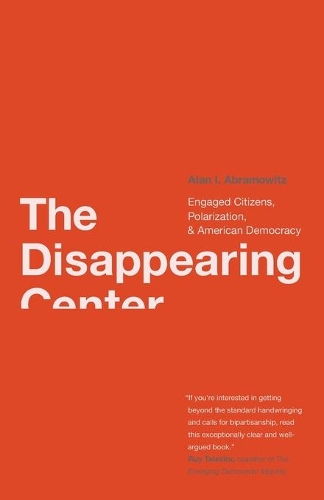
Renowned political scientist Alan I. Abramowitz presents a groundbreaking argument that the most important divide in American politics is not between left and right but rather between citizens who are politically engaged and those who are not. It is the engaged members of the public, he argues, who most closely reflect the ideals of democratic citizenship—but this is also the group that is most polarized. Polarization at the highest levels of government, therefore, is not a sign of elites’ disconnection from the public but rather of their responsiveness to the more politically engaged parts of it. Though polarization is often assumed to be detrimental to democracy, Abramowitz concludes that by presenting voters with clear choices, polarization can serve to increase the public’s interest and participation in politics and strengthen electoral accountability.
"
“Thought-provoking.”--Publishers Weekly
" - Publishers Weekly
"[An] important and persuasive new book."--Ethan Porter, Wilson Quarterly
- Wilson Quarterly
"Abramowitz admirably tackles many dimensions of a complex debate. . . . the book is an important text for both new and old students of polarization in American politics."—Hahrie Han, Public Opinion Quarterly - Public Opinion Quarterly