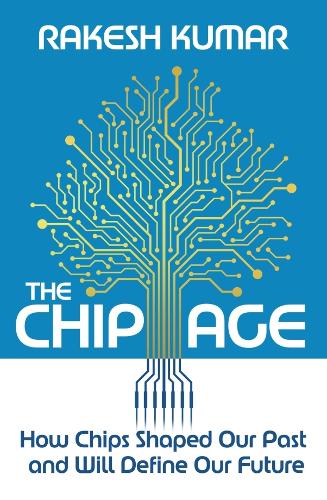
Книга The Chip Age: How Chips Shaped Our Past and Will Define Our Future
Chips are everywhere - they drive the world's economy and are at the centre of the struggle for global supremacy. But how did we come to live in the Chip Age? What does it mean for the future?
Rakesh Kumar has been developing technologies used in chips and advising chip companies and governments for decades. In this fascinating book, he explores the world of microchips and explains how they are central to today's world - if the nineteenth century was the age of the steam engine, the twenty-first century belongs to the chips.
Chips have changed the way we live, driving innovation, the economy and - increasingly - geopolitics and long-term global stability. They will be critical in determining the health of the planet. The Chip Age is a history of chips and explains how they work, what exactly they do, how and where they are made, who makes them, and the shape of the chip economy. It also looks to the future, examining what new technologies and geopolitical games may lie ahead.
"This expert and up-to-date primer on chipmaking is a must read if you're concerned about AI, the battle for resources it has sparked, and its environmental and economic consequences." - Peter Forbes, author of Thinking Small and Large
"This book brings out the criticality of microchips to all modern economies, and the dependencies of the global chip business on a large number of highly specialised companies based in countries all over the planet. The result is an enormous, fragile, complex, geopolitically-sensitive industry in which espionage, tariffs, export controls and dirty tricks play an increasing role, and to which increasing international tensions are a very worrying threat." - Steve Furber, a principal designer of the ARM 32-bit RISC microprocessor
"Brings home the immense significance of computer chips for modern technology and everyday life - and how fragile that ecosystem is." - Brian Clegg, author of The Quantum Age
"Nothing spans the range of human endeavour, from basic science to global politics, more than the computer chip. Rakesh Kumar does a superb job joining up the dots, presenting a stark realisation of how much we all depend on this remarkable piece of technology." - Tim Palmer, author of The Primacy of Doubt
"Explaining semiconductors to a lay audience is no mean feat, and Kumar does so admirably. The book is full of details that make a reader sit up ... flashes of excellent science writing." - Nature