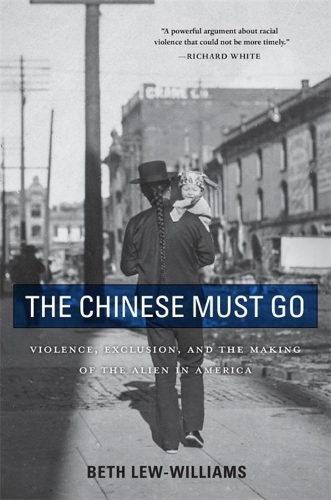
Книга The Chinese Must Go: Violence, Exclusion, and the Making of the Alien in America
Winner of the Ray Allen Billington Prize
Winner of the Ellis W. Hawley Prize
Winner of the Sally and Ken Owens Award
Winner of the Vincent P. DeSantis Book Prize
Winner of the Caroline Bancroft History Prize
“A powerful argument about racial violence that could not be more timely.”
—Richard White
“A riveting, beautifully written account…that foregrounds Chinese voices and experiences. A timely and important contribution to our understanding of immigration and the border.”
—Karl Jacoby, author of Shadows at Dawn
In 1885, following the massacre of Chinese miners in Wyoming Territory, communities throughout California and the Pacific Northwest harassed, assaulted, and expelled thousands of Chinese immigrants. The Chinese Must Go shows how American immigration policies incited this violence, and how this gave rise to the concept of the “alien” in America.
Our story begins in the 1850s, before federal border control established strict divisions between citizens and aliens—and long before Congress passed the Chinese Restriction Act, the nation’s first attempt to bar immigration based on race and class. When this unprecedented experiment failed to slow Chinese migration, armed vigilante groups took the matter into their own hands. Fearing the spread of mob violence, policymakers redoubled their efforts to seal the borders, overhauling immigration law and transforming America’s relationship with China in the process. By tracing the idea of the alien back to this violent era, Lew-Williams offers a troubling new origin story of today’s racialized border.
“The Chinese Must Go shows how a country that was moving, in a piecemeal and halting fashion, toward an expansion of citizenship for formerly enslaved people and Native Americans, came to deny other classes of people the right to naturalize altogether…The stories of racist violence and community shunning are brutal to read.”
—Rebecca Onion, Slate
"The Chinese Must Go shows how a country that was moving, in a piecemeal and halting fashion, toward an expansion of citizenship for formerly enslaved people and Native Americans, came to deny other classes of people the right to naturalize altogether…The stories of racist violence and community shunning are brutal to read. Lew-Williams particularly excels at invoking the psychological effects of the law on Chinese people living in the United States after the exclusion acts passed." - Slate
"In her skillful retelling of the history of white workers’ violence against Chinese immigrants and the formulation of laws to first restrict, and then exclude, Chinese laborers from the United States in the mid-late 19th century, Beth Lew-Williams weaves a story of racial discrimination and nativism that continues to resonate today." - South China Morning Post