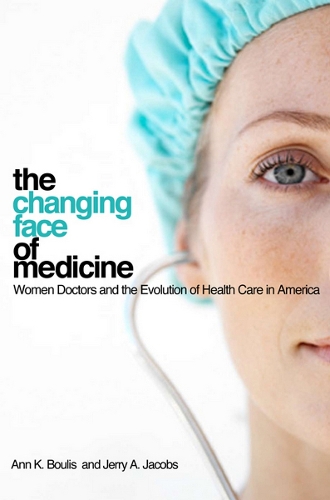
Книга The Changing Face of Medicine: Women Doctors and the Evolution of Health Care in America
The number of women practicing medicine in the United States has grown steadily since the late 1960s, with women now roughly at parity with men among entering medical students. Why did so many women enter American medicine? How are women faring, professionally and personally, once they become physicians? Are women transforming the way medicine is practiced?
To answer these questions, The Changing Face of Medicine draws on a wide array of sources, including interviews with women physicians and surveys of medical students and practitioners. The analysis is set in the twin contexts of a rapidly evolving medical system and profound shifts in gender roles in American society.
Throughout the book, Ann K. Boulis and Jerry A. Jacobs critically examine common assumptions about women in medicine. For example, they find that women's entry into medicine has less to do with the decline in status of the profession and more to do with changes in women's roles in contemporary society. Women physicians' families are becoming more and more like those of other working women. Still, disparities in terms of specialty, practice ownership, academic rank, and leadership roles endure, and barriers to opportunity persist. Along the way, Boulis and Jacobs address a host of issues, among them dual-physician marriages, specialty choice, time spent with patients, altruism versus materialism, and how physicians combine work and family.
Women's presence in American medicine will continue to grow beyond the 50 percent mark, but the authors question whether this change by itself will make American medicine more caring and more patient centered. The future direction of the profession will depend on whether women doctors will lead the effort to chart a new course for health care delivery in the United States.
The number of women practicing medicine in the United States has grown steadily since the late 1960s, with women now roughly at parity with men among entering medical students. Why did so many women enter American medicine? How are women faring, professionally and personally, once they become physicians? Are women transforming the way medicine is practiced? To answer these questions, The Changing Face of Medicine draws on a wide array of sources, including interviews with women physicians and surveys of medical students and practitioners. The analysis is set in the twin contexts of a rapidly evolving medical system and profound shifts in gender roles in American society.
Throughout the book, Ann K. Boulis and Jerry A. Jacobs critically examine common assumptions about women in medicine. For example, they find that women's entry into medicine has less to do with the decline in status of the profession and more to do with changes in women's roles in contemporary society. Women physicians' families are becoming more and more like those of other working women. Still, disparities in terms of specialty, practice ownership, academic rank, and leadership roles endure, and barriers to opportunity persist. Along the way, Boulis and Jacobs address a host of issues, among them dual-physician marriages, specialty choice, time spent with patients, altruism versus materialism, and how physicians combine work and family.
Women's presence in American medicine will continue to grow beyond the 50 percent mark, but the authors question whether this change by itself will make American medicine more caring and more patient centered. The future direction of the profession will depend on whether women doctors will lead the effort to chart a new course for health care delivery in the United States.
"
In 2009, half of all newly minted physicians will be female; in 1969 that figure was fewer than one in ten. In their detailed, data-driven portrait of the dramatic rise of women in medicine, Ann Boulis and Jerry Jacobs do an excellent job of explaining both the reasons for the trend toward numerical equality among physicians and its key consequences. They argue that women entered medicine primarily because broad barriers were lifted—not, as others have suggested, because women were more willing than men to accept (or contributed to) occupational status decline. In addition, as practicing physicians, women differ little from men in their overall patterns of care, and as future leaders of the profession they are unlikely to exhibit much difference in leadership style.
" - Industrial and Labor Relations Review"
The number of women entering medical school and residency and practicing medicine in the United States has grown steadily over the past four decades. The Changing Face of Medicine is an exploration of multiple aspects of this change, including societal developments, immigration, economics, and the women's movement.... This book will allow educators, administrations, reformers, and representatives of funding sources—as well as future physicians—to understand how American medicine came to be as it is now.
" - New England Journal of Medicine