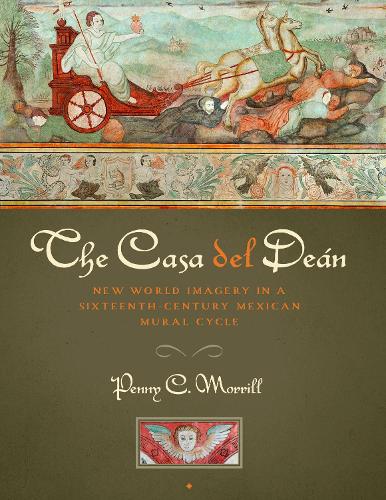
Книга The Casa del Deán: New World Imagery in a Sixteenth-Century Mexican Mural Cycle
"These images are striking, and collecting them together within the covers of a book is a contribution to colonial visual culture. Penny Morrill has done an exemplary job of tracking down primary materials that contextualize the murals and filling out our understanding of the patron, Don Tomas de la Plaza, the artist(s), and the sources and meanings of the murals' iconography... She has done a laudable job of examining the programmatic whole: that is, the way in which the murals complement one another to communicate a Christian message with humanist (neo-Platonic) imagery." -- Jeanette Favrot Peterson, Professor of Art and Architectural History at the University of California at Santa Barbara, and author of Visualizing Guadalupe: From Black Madonna to Queen of the Americas
The Casa del Deán in Puebla, Mexico, is one of few surviving sixteenth-century residences in the Americas. Built in 1580 by Tomás de la Plaza, the Dean of the Cathedral, the house was decorated with at least three magnificent murals, two of which survive. Their rediscovery in the 1950s and restoration in 2010 revealed works of art that rival European masterpieces of the early Renaissance, while incorporating indigenous elements that identify them with Amerindian visual traditions.
Extensively illustrated with new color photographs of the murals, The Casa del Deán presents a thorough iconographic analysis of the paintings and an enlightening discussion of the relationship between Tomás de la Plaza and the indigenous artists whom he commissioned. Penny Morrill skillfully traces how native painters, trained by the Franciscans, used images from Classical mythology found in Flemish and Italian prints and illustrated books from France—as well as animal images and glyphic traditions with pre-Columbian origins—to create murals that are reflective of Don Tomás’s erudition and his role in evangelizing among the Amerindians. She demonstrates how the importance given to rhetoric by both the Spaniards and the Nahuas became a bridge of communication between these two distinct and highly evolved cultures. This pioneering study of the Casa del Deán mural cycle adds an important new chapter to the study of colonial Latin American art, as it increases our understanding of the process by which imagery in the New World took on Christian meaning.
"Penny Morrill’s wonderful book The Casa del Dean is a clearly written, well-researched, and beautifully illustrated monograph that studies one of the few remaining private mural cycles of sixteenth-century Mexico. It is at once a depressing tale of the murals’ partial destruction in the twentieth century due to local disregard for Mexico’s patrimony as well as a gripping and surprising account of the history of their creation and significance." - Renaissance Quarterly
"The Casa del Deán is carefully researched and written clearly, and contributes to scholarship on early colonial Mexican art production and its cross-cultural complexities. Morrill’s examination of the connections between rhetoric and image production is particularly insightful, and her analyses of the salons’ murals are commendable for taking into account both European and indigenous rhetorical practices and pictorial traditions." - CAA Reviews