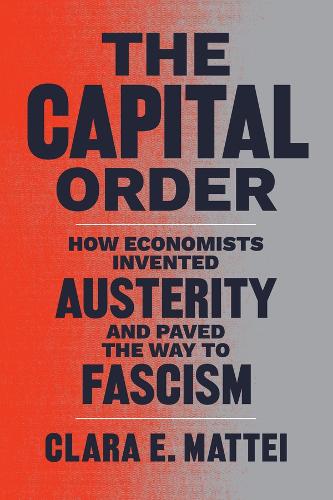
Книга The Capital Order: How Economists Invented Austerity and Paved the Way to Fascism
A Financial Times Best Book of the Year
"A must-read, with key lessons for the future."—Thomas Piketty
A groundbreaking examination of austerity’s dark intellectual origins.
For more than a century, governments facing financial crisis have resorted to the economic policies of austerity—cuts to wages, fiscal spending, and public benefits—as a path to solvency. While these policies have been successful in appeasing creditors, they’ve had devastating effects on social and economic welfare in countries all over the world. Today, as austerity remains a favored policy among troubled states, an important question remains: What if solvency was never really the goal?
In The Capital Order, political economist Clara E. Mattei explores the intellectual origins of austerity to uncover its originating motives: the protection of capital—and indeed capitalism—in times of social upheaval from below.
Mattei traces modern austerity to its origins in interwar Britain and Italy, revealing how the threat of working-class power in the years after World War I animated a set of top-down economic policies that elevated owners, smothered workers, and imposed a rigid economic hierarchy across their societies. Where these policies “succeeded,” relatively speaking, was in their enrichment of certain parties, including employers and foreign trade interests, who accumulated power and capital at the expense of labor. Here, Mattei argues, is where the true value of austerity can be observed: its insulation of entrenched privilege and its elimination of all alternatives to capitalism.
Drawing on newly uncovered archival material from Britain and Italy, much of it translated for the first time, The Capital Order offers a damning and essential new account of the rise of austerity—and of modern economics—at the levers of contemporary political power.
"The Capital Order uses the historical record in Europe to argue that austerity—tightening the belt, cutting government programs—is less about budgets and debt and more about deliberately making the labor force feel insecure." - APM's Marketplace Morning Report
"Mattei reminds us that . . . austerity is a one-sided class war, conducted in numbers and defended by economists’ jargon.” - The Guardian
"“Illuminating . . . Any reader of The Capital Order will be struck by the contemporary resonances.”" - The New Statesman
"In our current moment, as policymakers are once again entertaining monetary tightening as a means to impose necessary hardship & discipline on working people, The Capital Order is a potent reminder of the cruel rationality of austerity." - Dissent Magazine
"“Shocking disparities underlie economist Clara Mattei’s topical study of austerity measures promoted over the past century. Focusing on 1920s liberal-democracy Britain and fascist Italy, she argues that the profitable application of austerity to these dissimilar nations licensed its use as a capitalist ‘tool of class control.”" - Nature
"Mattei shows how austerity emerged as the response of international capital to the risks to its power and wealth. Its aim was to rescue capitalism from ‘its enemies’ by taming an increasingly politicized and restive class and restoring the prewar order." - History Today
"“[With The Capital Order], we can begin to see method in the madness: austerity is a vital bulwark in defense of the capitalist system.”" - Business Recorder
"“It’s often been pointed out that austerity just doesn’t achieve its stated aims of balancing the books and paying down public debt. [In Mattei’s] analysis the actual aim is not the stated one, it is to discipline the working population. Over the last century it would seem to have achieved that quite successfully.”" - The National
"“A serious economic history of the 1920s and its fiscal and credit policies, and you should not dismiss it.”" - Marginal Revolution
"“Brilliantly provocative . . . powerfully argued. . . . With her history of the relationship between liberal economists and fascism, Mattei puts the skids under complacent champions of liberal democracy who today summon the fascist figure as a reassuring boogyman. . . . A round house critique of the role of liberal economics in general.”" - Chartbook
"There are few books that once read manage to leave a clear idea and a full-fledged thesis imprinted on the reader’s mind: Chiara E. Mattei’s book is one of them." - The Journal of European Economic History
"She [Mattei] has done an impressive amount of archival research and has skillfully mined the published literature of the interwar period. The fruit of these labors is a rich and insightful account of a pivotal moment in capitalism’s history." - Catalyst
"“A powerful critique.”" - Asiana Times
"Through meticulously compiled archival material, Mattei explores austerity by studying economists in the 1920s from the birthplace of liberalism (Britain) and the birthplace of fascism (Italy) to draw a provocative conclusion about its nature: 'an anti-democratic reaction to threats from bottom-up social change.'” - Politics Today
"“She argues that forcing a recession or cutting social welfare is not really about budgets and debt. This so-called “economic pain” is inflicted deliberately to make the labour force feel insecure and to stop demanding better conditions.”" - Irish Examiner
"Austerity’s defenders claim that any adverse impact on employment will quickly end and will be justified by eventual success. Such is the theory. Clara Mattei will have none of it. Her vigorously written and well-researched new study, The Capital Order, insists that austerity is a class strategy, not just a policy to restore economic equilibrium." - European Review of Books
"
“There is a long history of efforts to separate the political from the economic domain. . . . One very impressive recent study, by Clara Mattei, argues persuasively that this dichotomy, typically taking the form of austerity programs, has been a major instrument of class war for a century, paving the way to fascism, which was indeed welcomed by Western elite opinion.”—Noam Chomsky
" - Truth Out"A 2022 Best Book in Economics" - Financial Times
"“[A] message for our time.”" - Brazzil Magazine
"The capital order asserts the primacy of capital over labor in the hierarchy of social relations within the capitalist production process. That primacy was threatened after World War I in what Mattei claims was the greatest crisis in the history of capitalism. . . . To counter these trends, Mattei argues, unelected technocratic elites 'invented' austerity as a means of re-naturalizing the capital order. . . . What Britain’s technocrats accomplished through the market, Italy’s fascists accomplished through Mussolini’s edicts. . . Recommended." - Choice
"In her book The Capital Order, economist Clara Mattei shows that austerity was thought of as a counter-offensive against experiments in economic democracy." - Alternatives Economiques
"A wonderful book [and a] compelling story." - Rethinking Economics
"“A very readable and historically profound work.”" - H/Soz/Kult
"Austerity is premeditated policy. It’s a blunt instrument that preempts resistance by weakening and dividing the working class while unifying different wings of the ruling class. . . . Mattei documents austerity’s essential role in the rise of fascism." - Counterpunch
"Meticulously researched. . . Mattei’s analysis is an exemplary work of historical political economy that seeks to steer the conversation on capitalist crisis from Keynesianism back toward Marx." - Phenomenal World