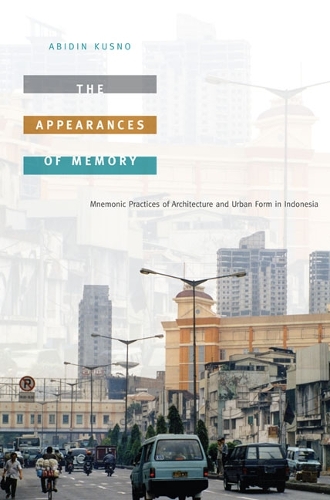
Книга The Appearances of Memory: Mnemonic Practices of Architecture and Urban Form in Indonesia
A study of post-Suharto Indonesia that focuses on the role of architecture and urban space in defining social changes, as well the role that such spaces play in forming social and political identities, particularly social memories.
In The Appearances of Memory, the Indonesian architectural and urban historian Abidin Kusno explores the connections between the built environment and political consciousness in Indonesia during the colonial and postcolonial eras. Focusing primarily on Jakarta, he describes how perceptions of the past, anxieties about the rapid pace of change in the present, and hopes for the future have been embodied in architecture and urban space at different historical moments. He argues that the built environment serves as a reminder of the practices of the past and an instantiation of the desire to remake oneself within, as well as beyond, one’s particular time and place.
Addressing developments in Indonesia since the fall of President Suharto’s regime in 1998, Kusno delves into such topics as the domestication of traumatic violence and the restoration of order in the urban space, the intense interest in urban history in contemporary Indonesia, and the implications of “superblocks,” large urban complexes consisting of residences, offices, shops, and entertainment venues. Moving farther back in time, he examines how Indonesian architects reinvented colonial architectural styles to challenge the political culture of the state, how colonial structures such as railway and commercial buildings created a new, politically charged cognitive map of cities in Java in the early twentieth century, and how the Dutch, in attempting to quell dissent, imposed a distinctive urban visual order in the 1930s. Finally, the present and the past meet in his long-term considerations of how Java has responded to the global flow of Islamic architecture, and how the meanings of Indonesian gatehouses have changed and persisted over time. The Appearances of Memory is a pioneering look at the roles of architecture and urban development in Indonesia’s ongoing efforts to move forward.
"“The Appearance of Memory is very much a revisionist work that deftly manages a plethora of knowledge and detail about the Indonesian city to provide new insight into its dynamics. The book is full of pithy summations that deftly capture well developed themes in Indonesian sociological studies, but, more importantly, it contextualizes these themes through insightful analysis of architectural forms.”" - Oceania
"“[Kusno] provides a brilliant diachronic cartography of different architectural and urban elements in contemporary Jakarta and their connection to or disjuncture from the past. . . . [T]his is an exceptional and truly enjoyable book, a good companion to the author’s previous book, Behind the Postcolonial (2000).”" - Planning Perspectives
"“[T]he essays are well-designed, their themes are carefully developed, and there is ample evidence to give credence to the conclusions that are drawn. The essays are scholarly, unambiguous, and meaningful to the reader. The use of examples from architecture are well-chosen and make the collection an especially good representative of this genre. The author’s two major themes. . .are a strong contribution to the scholarly literature on the history and architecture of Java. . . . [T]he work is well done and worth reading.”" - Indonesia
"“[U]nique and engaging. . . . [M]akes a considerable contribution to the discourse on ‘memory’ in architecture and urban studies, and in particular to broadening the understanding – and reading – of urban space within postcolonial nations.”" - Asia Pacific Viewpoint
"“This fine book has its origins in a series of essays published in the aftermath of the May 1998 rioting in Jakarta and the birth of the post-Suharto era, the product of the so-called reformasi. . . . Photos and line drawings feature
among some 60 illustrations, and there is a comprehensive bibliography, which includes, as might be expected, Indonesian and Dutch works. . . . I would highly recommend this book overall. . .”" - Architectural Science Review
"This…book demonstrates deep theoretical reflection on a number of different issues around the theme of memory as they are inscribed in material and spatial phenomena…. [Kusno] exposes social challenges that Asian nations deliberately suppress and architectural/urban studies rarely acknowledge." - Comparative Studies in Society and History