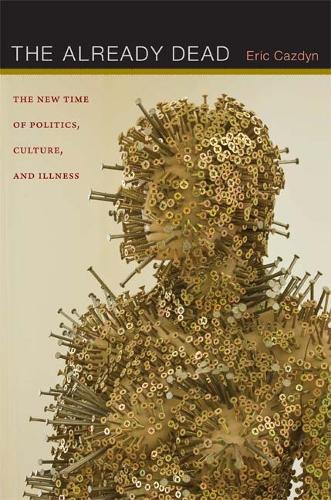
Книга The Already Dead: The New Time of Politics, Culture, and Illness
This book considers how a culture of crisis management--what Cazdyn calls "the new chronic"-- has come to dominate all aspects of contemporary life, from biomedicine to economics to politics. Drawing from his own experiences battling leukemia and the subsequent effects of his illness on the process of becoming a Canadian citizen, Cazdyn unravels the logic of the new chronic where people find themselves suspended in a space between life and death. He argues that we need a new form of revolution that will not seek to "cure" our social and political ills, but rather disrupts the temporal and spatial constraints of the current contemporary condition. The book touches on a lot of issues that are central to our list, including global capitalism, biomedicine, immigration, and the power and limitations of the modern nation-state.
In The Already Dead, Eric Cazdyn examines the ways that contemporary medicine, globalization, politics, and culture intersect to produce a condition and concept that he names "the new chronic." Cazdyn argues that just as contemporary medicine uses targeted drug therapies and biotechnology to manage rather than cure diseases, global capitalism aims not for resolution but rather for a continual state of crisis management that perpetuates the iniquities of the status quo. Engaging critical theory, philosophy, and psychoanalysis, he explores the ways that crisis affects perceptions of time and denies alternative ways of being and thinking.
To resist the exploitative crisis state, which Cazdyn terms "the global abyss," he posits the concept of "the already dead," a condition in which the subject (medical, political, psychological) has been killed but has yet to die. Embracing this condition, he argues, allows for a revolutionary consciousness open to a utopian future. Woven into Cazdyn's analysis are personal anecdotes about his battle with leukemia and his struggle to obtain Canadian citizenship during his illness. These narratives help to illustrate his systemic critique, one that reconfigures the relationship between politics, capitalism, revolution, and the body.
"“Cazdyn’s treatise is provocative, creative, and intelligent, calling for no less than a global revolution in action and ideology. Anchored in American events and history, it also has much to offer at the international level, and it will be a welcome companion to a wide range of curricula in the humanities, medical, and social sciences.” " - Journal of American Culture
"“While it is not the only reason to read the book, it is the performance itself, the manner in which Cazdyn artfully combines three areas of study and speaks of them in parallel with one another, that is most valuable, no matter the discipline to which the reader belongs. Cazdyn invokes a system that is both utopian (in its impossible future – the American Dream is always just a step away) and pre-apocalyptic.” " - Science Fiction Film and Television
"“Cazdyn covers a dizzying array of examples of the way this shift has become normalized–drawn from popular culture, cinema, and literature. One must pause to marvel at the facility with which he melds such analysis with moving personal essays.” " - U.S. Intellectual History Blog
"“This book is a roller-coaster ride through a broad swath of cultural studies, psychoanalysis and the social sciences—from the relationship of the chronic subject to phenomena in capitalism, biopolitics and global formations, and from trends in medicine to descriptions of how death and life are brought together in the literary and psychoanalytic imagination.”" - Culture, Health & Sexuality
"“The Already Dead comes at a critical moment in which the vulgarities of the global capitalist system have become increasingly difficult to conceal. The book’s approach, at once theoretical and personal, historical and cultural, seeks new modes of revolutionary consciousness that can destabilize both within and without the capitalist system so as to reconfigure everything.”" - Reviews in Cultural Theory