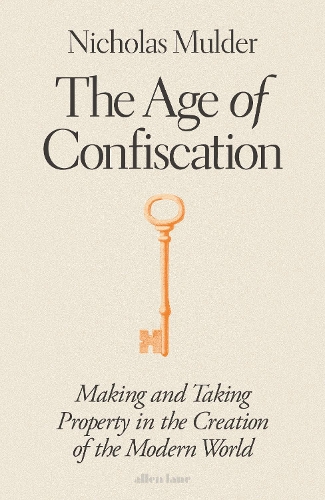
Книга The Age of Confiscation: Making and Taking Property in the Creation of the Modern World
A sweeping, resonant, revelatory history of how the expropriation of property made the modern world, by a brilliant young historian
A sweeping, resonant, revelatory history of how the expropriation of property made the modern world, by a brilliant young historian
Expropriation – the forced transfer of property rights – is usually associated with dictators, unstable countries, and violent revolution. But in fact, it has been integral to the political and economic history of the West, enabling everything from the abolition of serfdom and slavery to decolonization, Allied victory in two world wars and the birth of the modern welfare state. For better and for worse, much of our modern world was built through coercive acquisition of property.
In this groundbreaking international history of expropriation, Nicholas Mulder charts a gripping course from the eighteenth century to the present, ranging from the French Revolution to the Russo-Ukrainian War, from colonial companies to railway empires, from sales of church land to oil nationalizations, and from the confiscation of patents to asset freezing in the Eurodollar market. He shows how all kinds of political movements – liberal and nationalist, socialist and fascist, imperialist and anticolonial – both dissolved and redistributed property rights. Successful state-building did not depend on extinguishing the confiscatory state, but on capitalists mastering its powers and redeploying them for their own purposes.
Drawing on a vast range of sources and data across history, politics, and economics, Mulder unfolds a bold revisionist history of how property was made and unmade, transferred and converted, stolen and restored. The Age of Confiscation reveals how much expropriation has been part of our recent past, and how amid rising geopolitical competition, growing inequality, and climate change, it will mark our future.
"Nicholas Mulder shows us that the modern world is largely about the codification of property rights - but it is also about large redistributions of wealth. A major lesson for the age of climate catastrophes, a must-read" - Thomas Piketty
"Nicholas Mulder flips the economic history of the last 250 years on its head. A jaw dropping accomplishment" - Quinn Slobodian
"An impressive history ... The Age of Confiscation arrives just in time to inform a variety of contemporary debates about economic statecraft" - Financial Times
"Mulder’s gift for lucid synthesis makes it a pleasure to read" - Literary Review
"Mulder's illuminating study challenges one of capitalism's most enduring narratives: that private property exists apart from state intervention. He reveals expropriation as a central instrument of modern governance, showing how private owners have not only survived but often profited from the very processes that transformed their property" - Clara Mattei
"A revelatory global history of struggle between rulers and subjects over who owns what" - Kirkus
"Confiscation is back with a bang. Trump demands government shares in business, centrists want to blow up local opposition to development, and the left dreams of remaking the economy. Nicholas Mulder explains with verve and intelligence that property rights were never as solid as they seemed, and sets the scene for what happens next" - Henry Farrell
"A piercing examination of a bedrock mechanism of modern society" - Publishers Weekly
"Mulder's provocative tour de force beckons readers interested in understanding not only the history but also the implications for the present and future of coercive transfers of property" - Library Journal