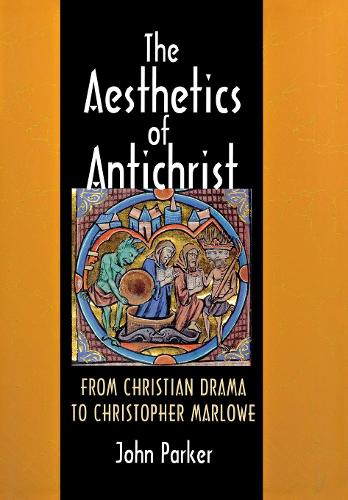
Книга The Aesthetics of Antichrist: From Christian Drama to Christopher Marlowe
In Dr. Faustus, Christopher Marlowe wrote a profoundly religious drama despite the theater's newfound secularism and his own reputation for anti-Christian irreverence. The Aesthetics of Antichrist explores this apparent paradox by suggesting that, long before Marlowe, Christian drama and ritual performance had reveled in staging the collapse of Christianity into its historical opponents—paganism, Judaism, worldliness, heresy. By embracing this tradition, Marlowe's work would at once demonstrate the theatricality inhering in Christian worship and, unexpectedly, resacralize the commercial theater.
The Antichrist myth in particular tells of an impostor turned prophet: performing Christ's life, he reduces the godhead to a special effect yet in so doing foretells the real second coming. Medieval audiences, as well as Marlowe's, could evidently enjoy the constant confusion between true Christianity and its empty look-alikes for that very reason: mimetic degradation anticipated some final, as yet deferred revelation. Mere theater was a necessary prelude to redemption. The versions of the myth we find in Marlowe and earlier drama actually approximate, John Parker argues, a premodern theory of the redemptive effect of dramatic representation itself.
Crossing the divide between medieval and Renaissance theater while drawing heavily on New Testament scholarship, Patristics, and research into the apocrypha, The Aesthetics of Antichrist proposes a wholesale rereading of pre-Shakespearean drama.
In Dr. Faustus, Christopher Marlowe wrote a profoundly religious drama despite the theater's newfound secularism and his own reputation for anti-Christian irreverence. The Aesthetics of Antichrist explores this apparent paradox by suggesting that, long before Marlowe, Christian drama and ritual performance had reveled in staging the collapse of Christianity into its historical opponents—paganism, Judaism, worldliness, heresy. By embracing this tradition, Marlowe's work would at once demonstrate the theatricality inhering in Christian worship and, unexpectedly, resacralize the commercial theater.
The Antichrist myth in particular tells of an impostor turned prophet: performing Christ's life, he reduces the godhead to a special effect yet in so doing foretells the real second coming. Medieval audiences, as well as Marlowe's, could evidently enjoy the constant confusion between true Christianity and its empty look-alikes for that very reason: mimetic degradation anticipated some final, as yet deferred revelation. Mere theater was a necessary prelude to redemption. The versions of the myth we find in Marlowe and earlier drama actually approximate, John Parker argues, a premodern theory of the redemptive effect of dramatic representation itself. Crossing the divide between medieval and Renaissance theater while drawing heavily on New Testament scholarship, Patristics, and research into the apocrypha, The Aesthetics of Antichrist proposes a wholesale rereading of pre-Shakespearean drama.
"
Although his subtitle suggests a primary concern with medieval and early modern drama, John Parker's book attempts nothing less than a master theory of Christianity.... No critic before Parker has ever attempted such an ambitious project of reading the late-medieval cycle plays through modern scholarly debates about the formation of the biblical canon. Throughout the book he writes with a passion for ideas and argument that is hard to find in most books on premodern drama.... He fittingly concludes with a long chapter on Marlowe, a playwright who has been read as both an orthodox Christian and as a de facto representative of Antichrist. Having spent the entire book tracing convergences between type and antitype, Parker argues convincingly that Marlowe is indeed both.
" - Speculum