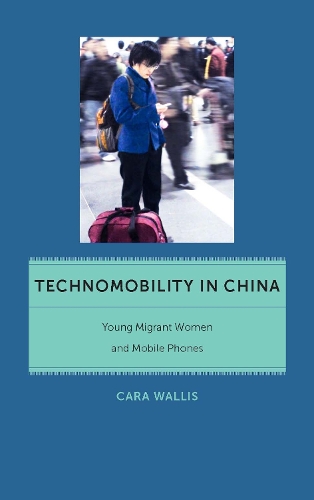
Книга Technomobility in China: Young Migrant Women and Mobile Phones
Provides original insight into the co-construction of technology and subjectivity as well as the multiple forces that shape contemporary China
Winner of the 2014 Bonnie Ritter Book Award
Winner of the 2013 James W. Carey Media Research Award
As unprecedented waves of young, rural women journey to cities in China, not only to work, but also to “see the world” and gain some autonomy, they regularly face significant institutional obstacles as well as deep-seated anti-rural prejudices. Based on immersive fieldwork, Cara Wallis provides an intimate portrait of the social, cultural, and economic implications of mobile communication for a group of young women engaged in unskilled service work in Beijing, where they live and work for indefinite periods of time.
While simultaneously situating her work within the fields of feminist studies, technology studies, and communication theory, Wallis explores the way in which the cell phone has been integrated into the transforming social structures and practices of contemporary China, and the ways in which mobile technology enables rural young women—a population that has been traditionally marginalized and deemed as “backward” and “other”—to participate in and create culture, allowing them to perform a modern, rural-urban identity. In this theoretically rich and empirically grounded analysis, Wallis provides original insight into the co-construction of technology and subjectivity as well as the multiple forces that shape contemporary China.
"InTechnomobility in China, Wallis brings the story of young female migrant labourers to public attention. Their aspirations and the different strategies they use to & get by in the city cuts through the stereotype that they are passive vessels waiting for instruction. The thick descriptions accompanying Wallis arguments of the ideological, social and economic barriers that tend to limit the success of migrant workers efforts drive this point home: these barriers are neither necessary nor deterministic. Perhaps, just as Wallis gave back to the community while conducting her ethnography, her book will contribute to the improvement of the social and political conditions migrant labourers face." - Pacific Affairs
"Wallis decision to study mobile phone use among the worlds largest migrant population possesses a natural affinity, which seems destined from the outset to deliver noteworthy findings. The resultant volume is made all the more remarkable owing to the surprising discovery that her participants young rural migrant women working in Beijings service sector are in fact defined by their experience of numerous forms of immobility." - Social Anthropology
"An interesting, well-researched, and well-supported study." - Choice