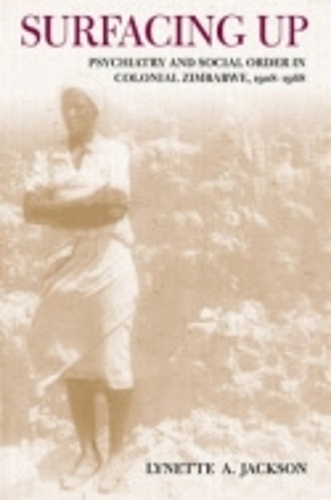
Книга Surfacing Up: Psychiatry and Social Order in Colonial Zimbabwe, 1908–1968
Focusing on the history of the Ingutsheni Lunatic Asylum (renamed a mental hospital after 1933), situated near Bulawayo in the former Southern Rhodesia, Surfacing Up explores the social, cultural, and political history of the colony that became Zimbabwe after gaining its independence in 1980. The phrase "surfacing up" was drawn from a conversation Lynette A. Jackson had with a psychiatric nurse who used the concept to explain what brought African potential patients into the psychiatric system. Jackson uses Ingutsheni as a reference point for the struggle to "domesticate" Africa and its citizens after conquest. Drawing on the work of Frantz Fanon, Jackson maintains that the asylum in Southern Rhodesia played a significant role in maintaining the colonial social order. She supports Fanon's claim that colonial psychiatric hospitals were repositories for those of "indocile nature" or for those who failed to fit "the social background of the colonial type."
Through reconstruction and reinterpretation of patient narratives, Jackson shows how patients were diagnosed, detained, and deemed recovered. She draws on psychiatric case files to analyze the changing economic, social, and environmental conditions of the colonized, the varying needs of the white settlers, and the shifting boundaries between these two communities. She seeks to extend and enrich our understanding of how a significant institution changed the way citizens and subjects experienced the colonial social order.
"
Lynnette Jackson's Surfacing Up carries on the project of exposing what Franz Fanon called the 'pathology of colonialism.' This book is important in three major ways. First, it comes in the wake of Achille Mbembe's critique of this genre of defining and writing the 'African' experience as a 'cult of victimization,' and his call for a robust self-reflexive reappraisal of the authenticity and redemption of African nationalism. Second, Jackson approaches these broader debates on Africa—inspired by Fanon, Aime Cesaire, and others—from the standpoint of health and healing in Africa. She tells her story within the thematic of therapeutic options available to Africans during the colonial moment, dwelling on the limits of such latitude, especially for those judged insane. Third, and overall, Surfacing Up is a theoretical and methodological statement on the fate of western-designed artifacts, ideas, and people that travel beyond metropolitan societies to colonies. Hence the book speaks to scholars—particularly historians—of Zimbabwe, Southern Africa, Africa, colonial and postcolonial studies, science and technology, psychiatry, gender, women's studies, and feminism.
" - H-SAfrica