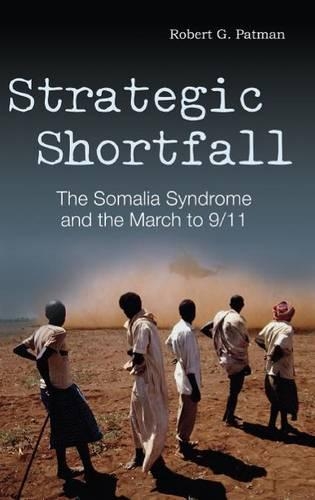
Книга Strategic Shortfall: The Somalia Syndrome and the March to 9/11
"In this challenging new study on the origins of 9/11 Robert Patman makes the crucial and too often forgotten point: that the the very real threat now presented by global terrorism was by no means preordained by history. Rather it is - in his view - the result of wrong lessons drawn from the combined failures of western and US policy in Somalia in the early 1990s. The collapse of Somalia is thus given the importance it so obviously deserves in explaining how and why the West turned a blind eye to the rising tide of Islamic extremism in the last decade of the twentieth century and with what devastating consequences for us all in the 21st. A compelling and well reasoned analysis that deserves the widest possible readership by policy-makers and serious students of world affairs alike." -- Professor Michael Cox, Co- Director of IDEAS and Department of International Relations, London School of Economics "In this first truly comprehensive treatment of the influence of the 'Somalia Syndrome' on U.S. foreign policy and world (dis)order, Robert Patman makes a vital contribution to our understanding of security challenges in the early 21st Century. This tragic yet poignant tale is one whose lessons we cannot afford to ignore. Scholars and policy makers alike will find this book both richly rewarding and profoundly sobering." -- David A. Welch CIGI Chair of Global Security, Balsillie School of International Affairs Professor of Political Science, University of Waterloo "Essential reading: always clear and well-documented. Professor Patman shows how the fear of another Somalia came to haunt US politics and foreign policy under Clinton and Bush, consolidating their opponents and allowing the wild gamble of '9/11' to seem a realistic option." -- Peter Calvert, Emeritus Professor of Comparative and International Politics, University of Southampton, England "In Strategic Shortfall, Robert Patman argues persuasively that America's-and the world's-failure to deal appropriately and fully with Somalia's failing state in the early 1990's was a harbinger of the events of September 11. Patman's careful development of this provocative thesis, his identification of the Somalia Syndrome in American foreign policy, and his systematic tracing of the linkages between Somalia and 9/11 make the volume 'must reading' for all serious students of foreign policy. The volume deserves, and should receive, wide readership." -- James M. McCormick, Iowa State University "Robert Patman provides a sensitive, analytically strong and clearly organized account of the changes in international security in general and U.S. foreign policy in particular since the end of the Cold War. Drawing on a wide range of rare sources, Patman is conveying his message that the "war on terrorism" has a history in a lucid and elegant fashion. Had the Somali intervention succeeded, the history of international and transnational terrorism in the last two decades would have been different. This is a unique and highly valuable book and a must read for practitioners of foreign and security policy and academics alike." -- Dr. Dirk Nabers, Head of Research for Power, Norms and Governance in IR and Academic Director, Hamburg International Graduate School for the Study of Regional Powers, GIGA German Institute of Global and Area Studies "Following in the path of the classic book by E. H. Carr, The Twenty Years' Crisis: 1919-1939, Patman has with concise clarity identified the second twenty years' crisis (1989-2009)-the path from the end of the Cold War to the war on terror-with the darkness of Somalia at its heart." -- Stan Taylor, Emeritus Professor of Political Science and founding Director of the David M. Kennedy Center for International Studies, Brigham Young University, Provo, Utah "A unique and timely book for today's decision-makers. Demonstrating a mastery of the Somalian intervention and its policy aftermath, Professor Patman sheds real light on the circumstances preceding the 9/11 attacks." -- Robert Ayson, Professor of Strategic Studies, Victoria University of Wellington, New Zealand "Patman's account of the Somali Syndrome and its role in shaping 9/11 convincingly refutes those who argue that national security policy remains the exclusive purview of the state. This book is a 'must read' for anyone interested in understanding how U.S. power has been misconstrued and misapplied in an increasingly globalised world." -- Professor William T. Tow, Australian National University "Strategic Shortfall is a deeply thoughtful and challenging account of the early post-Cold War era, ingeniously using the history and fate of Somalia as a prism through which fundamental questions are raised about the changing nature of the international system and, above all, America's place within it. It deserves a wide readership." -- Professor Mats Berdal, Department of War Studies, King's College London, UK "Patman's short book has big implications, especially for anyone anxious to understand our current predicaments. In clearly articulated prose, Strategic Shortfall shows how the US failed to learn the right lessons from Somalia as surely as it failed to do so from Vietnam. The consequences have proved epoch-making, both for the US's ideas of the post-Cold War global order, humanitarian intervention and counter-insurgency, and for Al Qaeda's view of the US, terrorism and the effectiveness of force." -- Hew Strachan, Chichele Professor of the History of War at Oxford University, UK "Robert Patman provides an excellent account and a convincing argument that the attack on 9/11 was not an intelligence failure so much as a failure to conduct an intelligent strategy for a changing and globalizing world. The book should be read by all those who are manifestly struggling to form such a strategy and those who observe them with alarm as current events unfold." -- General Sir Rupert Smith, KCB DSO OBE QGM
This seminal work argues that the disastrous raid in Mogadishu in 1993, and America's resulting aversion to intervening in failed states, led to the Rwanda and Bosnia genocides and to the 9/11 attacks.
Contrary to conventional wisdom, this book argues, it was not the 9/11 attacks that transformed the international security environment. Instead, it was "Somali Syndrome," an aversion to intervening in failed states that began in the wake of the1993 U.S./UN action in Somalia. The botched raid precipitated America's strategic retreat from its post-Cold War experiment at partnership with the UN in nation-building and peace enforcement and engendered U.S. paralysis in the face of genocide in Rwanda, Bosnia, and Darfur. The ensuing international security vacuum emboldened al-Qaeda to emerge and attack America and inaugurated our present era of intrastate conflict, mass killings, forced relocations, and international terrorism.
As this even-handed treatment shows, the Somali crisis can be connected to seven key features of the emerging post-Cold War world security order. These include the fact that failed states are now the main source of world instability and that new wars are driven by racial, ethnic, and religious identity issues.
- 15 illustrations