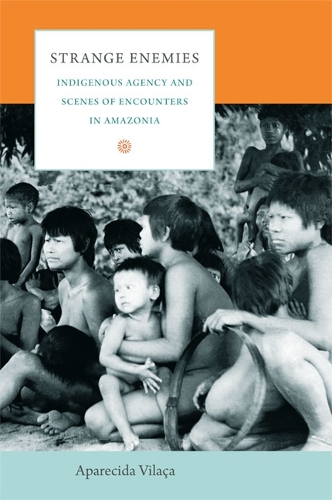
Книга Strange Enemies: Indigenous Agency and Scenes of Encounters in Amazonia
This ethnography--translated from the Portuguese-- describes the first encounters between the Wari' Indians and whites, and is the only monographic study to date about the process of contacting a previously isolated indigenous group in the South American
In 1956, in the Brazilian state of Rondônia, a group of Wari’ Indians had their first peaceful contact with whites: Protestant missionaries and officers from the national Indian Protection Service. On returning to their villages, the Wari’ announced, “We touched their bodies!” Meanwhile the whites reported to their own people that “the region’s most warlike tribe has entered the pacification phase!” Initially published in Brazil, Strange Enemies is an ethnographic narrative of the first encounters between these peoples with radically different worldviews.
During the 1940s and 1950s, white rubber tappers invading the Wari’ lands raided the native villages, shooting and killing their victims as they slept. These massacres prompted the Wari’ to initiate a period of intense retaliatory warfare. The national government and religious organizations subsequently intervened, seeking to “pacify” the Indians. Aparecida Vilaça was able to interview both Wari’ and non-Wari’ participants in these encounters, and here she shares their firsthand narratives of the dramatic events. Taking the Wari’ perspective as its starting point, Strange Enemies combines a detailed examination of these cross-cultural encounters with analyses of classic ethnological themes such as kinship, shamanism, cannibalism, warfare, and mythology.
"“[B]road scope makes Strange Enemies a book that should be read even by anthropologists who have little familiarity with Amazonia. It is a compelling example of the vital work that has been emerging from Amazonian anthropologists for the past decade. Like the best of that work, it offers us glimpses into worldviews and practices that are nothing if not mesmerizingly ‘far out.’ And it uses those worldviews and practices to develop insights and conclusions that are unexpected and exhilarating.”" - American Ethnologist
"“Aparecida Vilaça’s book, first published in Portuguese in 2006, is an excellent contribution to the anthropology of Amazonia and Melanesia. . . . Vilaça’s book is recommended as important reading to anthropologists, students, and the general reader interested in understanding’ the Other’ in our modern world.”" - Colonial Latin American Historical Review
"“Strange Enemies is the best ethnography ever written about a first contact history and thus probably the single most anthropologically satisfying publication of any kind for thinking about this subject.”" - American Anthropologist
"“The book is a well-written, highly readable, profound and original ethnographic and analytic contribution to Amazonian ethnology and ‘first encounter’ literature, such that any divergence in interpretation will also need an extended argument: it should be read by everyone interested in the subject.”
" - European Review of Latin American and Caribbean Studies
"“Among the many works on first contact between Indians and non-Indians, Strange Enemies stands out for its illuminating focus on indigenous perspectives and its sophisticated analysis of how the Wari’ conceived of historical change.”" - Ethnohistory
"This work has profound and far-reaching implications for anthropologists and historians who examine the frontiers of colonialism and globalization. . . . This is contemporary ethnography at its best, skillfully weaving together nuanced theoretical arguments, rich prose and storytelling, and insights that can only be gained by immersion in local settings. . . . Vilaça’s remarkable depiction of the coherence and resilience of native Amazonian peoples even in the face of catastrophic change is a must read for anyone interested in colonialism, globalization, and the place of indigenous peoples in the modern world.”" - American Historical Review