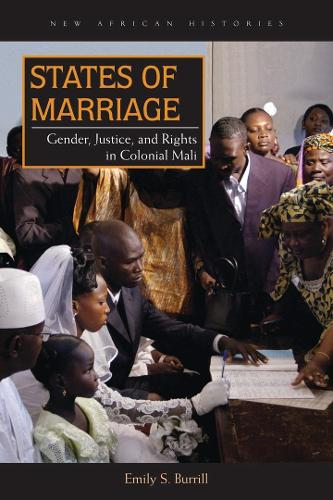
Книга States of Marriage: Gender, Justice, and Rights in Colonial Mali
States of Marriage shows how throughout the colonial period in French Sudan (present-day Mali) the institution of marriage played a central role in how the empire defined its colonial subjects as gendered persons with certain attendant rights and privileges.
States of Marriage shows how throughout the colonial period in French Sudan (present-day Mali) the institution of marriage played a central role in how the empire defined its colonial subjects as gendered persons with certain attendant rights and privileges. The book is a modern history of the ideological debates surrounding the meaning of marriage, as well as the associated legal and sociopolitical practices in colonial and postcolonial Mali. It is also the first to use declassified court records regarding colonialist attempts to classify and categorize traditional marriage conventions in the southern region of the country.
In French Sudan, as elsewhere in colonial Africa, the first stage of marriage reform consisted of efforts to codify African marriages, bridewealth transfers, and divorce proceedings in public records, rendering these social arrangements “legible” to the colonial administration. Once this essential legibility was achieved, other, more forceful interventions to control and reframe marriage became possible. This second stage of marriage reform can be traced through transformations in and by the colonial court system, African engagements with state-making processes, and formations of “gender justice.” The latter refers to gender-based notions of justice and legal rights, typically as defined by governing and administrative bodies as well as by socioxadpolitical communities. Gender justice went through a period of favoring the rights of women, to a period of favoring patriarchs, to a period of emphasizing the power of the individual—but all within the context of a paternalistic and restrictive colonial state.
"“Burrill sets out an ambitious agenda for ‘doing’ the history of marriage in her introductory chapter, one that will serve as an inspiration and guide for those who embark on similar studies. She does not provide—nor could anyone—a history of the institution of marriage, but rather a steady gaze into the actors and their struggles around marriage, divorce, and gender relationships over six decades. … Burrill has written a work of considerable and pioneering importance.”" - International Journal of African Historical Studies
"“A theoretically sound, gender-specific legal history through the reading of civil and criminal court records on marriage disputes in Sikasso, Mali.… The book echoes the original contribution of Nkiru Nzegwu (in Family Matters, 2006) that the oppression and exploitation of women were at the center of colonial policy. Burrill analyzes this history of legalized oppression at the local, national, and transnational levels. …Summing up: Recommended.”" - CHOICE
"“Emily Burrill’s insightful analysis of marriage, gender justice, and rights in colonial Mali deftly analyzes the ways in which colonial laws on marriage … both contributed in essential ways to the colonial state-building project and undermined existing social dynamics, thereby ‘unmaking the world.’ … Burrill’s book is a welcome addition to our understanding of gender, justice, human rights, and the colonial state. It is persuasive and well written and is essential reading for scholars interested not only in colonialism and gender but also in law and society.”" - African Studies Review