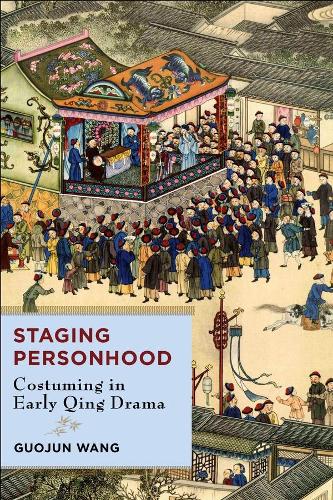
Книга Staging Personhood: Costuming in Early Qing Drama
After toppling the Ming dynasty, the Qing conquerors forced Han Chinese males to adopt Manchu hairstyle and clothing. Yet China’s new rulers tolerated the use of traditional Chinese attire in performances, making theater one of the only areas of life where Han garments could still be seen and where Manchu rule could be contested.
Staging Personhood uncovers a hidden history of the Ming–Qing transition by exploring what it meant for the clothing of a deposed dynasty to survive onstage. Reading dramatic works against Qing sartorial regulations, Guojun Wang offers an interdisciplinary lens on the entanglements between Chinese drama and nascent Manchu rule in seventeenth-century China. He reveals not just how political and ethnic conflicts shaped theatrical costuming but also the ways costuming enabled different modes of identity negotiation during the dynastic transition. In case studies of theatrical texts and performances, Wang considers clothing and costumes as indices of changing ethnic and gender identities. He contends that theatrical costuming provided a productive way to reconnect bodies, clothes, and identities disrupted by political turmoil. Through careful attention to a variety of canonical and lesser-known plays, visual and performance records, and historical documents, Staging Personhood provides a pathbreaking perspective on the cultural dynamics of early Qing China.
"A cogently written and deeply researched book, full of interpretative insights and rarely discussed materials. An important contribution to the study of Qing literature and history, this book will be a rich trove for all scholars interested in performances of gender and ethnicity in the early modern world." - Journal of Asian Studies
"The arguments that Wang makes are richly detailed and compelling. I strongly recommend it to people interested in gender and ethnicity in the Qing, as well as scholars of fiction and drama." - International Journal of Comparative Literature
"Benefit[s] scholars and students whose interest are not just limited to traditional Chinese theater or late imperial China, but more broadly in historical understandings of the Manchu empire and boundaries between self and others in terms of ethnic and gender relations." - Nan Nu
"An exciting read even for those who know very little about Chinese or theater history. It is delicately edited and presented in a manner that is easy to grasp while also offering a wealth of complex information and philosophical interpretations of this historic contextualization." - Pennsylvania Literary Journal
"By excavating how the individual body was transformed and how personhood, identity, and cultural mentality were shaped through costuming in literary writing, Wang refreshingly recenters the body in the study of classical Chinese dramatic literature." - Theatre Journal
"The result of Wang’s skilful deconstruction of early Qing costuming is a rich piece of scholarship[.]" - East Asian Journal of Popular Culture
"Wang has uncovered a fascinating context for studying Chinese theater that has been hiding in plain sight...This is a book that repays more than one reading." - T'oung Pao