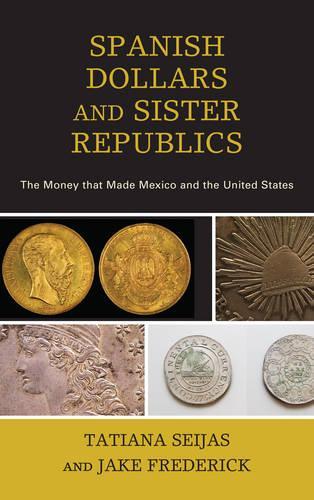
Книга Spanish Dollars and Sister Republics: The Money That Made Mexico and the United States
Spanish Dollars and Sister Republics traces the linked history of the new nations of Mexico and the United States from the 1770s to the 1860s. Tatiana Seijas and Jake Frederick highlight the common challenges facing both countries in their early decades of independence by exploring the creation of coin money. The remarkable story begins when both countries chose the Spanish piece of eight (silver coin) as their monetary standard. The authors examine how each nation instituted its own currency, designed coins to represent its national ideals, and then spent decades trying to establish the legitimacy of its money. Readers learn about the creation and circulation of money through the stories of a banker in Philadelphia, a Mexican general in Texas, a surveyor in Sonora, and others. The focus on individuals provides an engaging window into the economic history of Mexico and the United States. Seijas and Frederick show how the creation of U.S. dollars and Mexican pesos paralleled these countries’ efforts to establish enduring political and economic systems, illustrating why these nations closed the nineteenth century on very different historical trajectories.
"This is an original work that does a good job of connecting complex monetary and banking processes with the crucial political events of the period." - American Historical Review
"The authors contend that Spanish pieces of eight were the first global currency in 1535 and that Spanish silver coinage minted in the New World became the model for currency in the emerging republics of Mexico and the US. A single piece of eight was worth eight Spanish reales and required a standard silver content, coinage mints, banks, and treasury departments to flourish. Merchants in both South America and North America valued these coins (called ‘Spanish milled dollars’ in the British colonies) above all other currencies. Hard currency from anywhere was scarce in Colonial America, both South and North; merchants relied on credit, local tokens, and barter to conduct business. Mexico and the US had similar currency problems in the Colonial era after they each achieved independence. Eight profiles of key individuals illustrate the establishment of currency stability in both countries: Congressman John Page, merchant Stephen Girard, José Esteva (Mexican treasurer), President Sam Houston (Texas ), President López de Santa Anna (Mexico), boundary commissioner John Bartlett, Robert Patterson (director, US Mint), and Emperor Maximilian (Mexico). Concise and pithy, this engaging volume is recommended for students of economic and financial history. Summing Up: Recommended. Upper-division undergraduates and above." - CHOICE