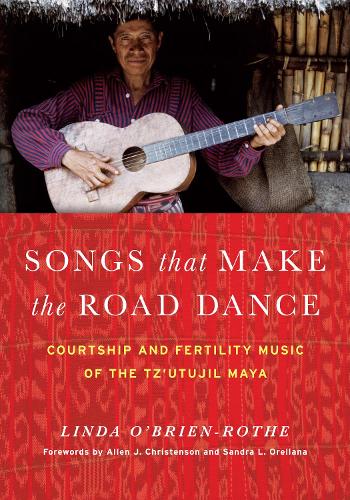
Книга Songs that Make the Road Dance: Courtship and Fertility Music of the Tz'utujil Maya
"This book is just as important, I believe, as early Colonial indigenous Titles and Testaments for the study of highland Maya theology and worldview. The interpretive material in the book is sound and well grounded in relevant current scholarship, but O'Brien wisely lets the Tz'utujils speak for themselves for the most part." -- Allen J. Christenson, Professor of Humanities, Classics, and Comparative Literature, Brigham Young University; author of Art and Society in a Highland Maya Community; and translator and editor of Popol Vuh: The Sacred Book of the Maya
An important and previously unexplored body of esoteric ritual songs of the Tz’utujil Maya of Santiago Atitlán, Guatemala, the “Songs of the Old Ones” are a central vehicle for the transmission of cultural norms of behavior and beliefs within this group of highland Maya. Ethnomusicologist Linda O’Brien-Rothe began collecting these songs in 1966, and she has amassed the largest, and perhaps the only significant, collection that documents this nearly lost element of highland Maya ritual life.
This book presents a representative selection of the more than ninety songs in O’Brien-Rothe’s collection, including musical transcriptions and over two thousand lines presented in Tz’utujil and English translation. (Audio files of the songs can be downloaded from the UT Press website.) Using the words of the “songmen” who perform them, O’Brien-Rothe explores how the songs are intended to move the “Old Ones”—the ancestors or Nawals—to favor the people and cause the earth to labor and bring forth corn. She discusses how the songs give new insights into the complex meaning of dance in Maya cosmology, as well as how they employ poetic devices and designs that place them within the tradition of K’iche’an literature, of which they are an oral form. O’Brien-Rothe identifies continuities between the songs and the K’iche’an origin myth, the Popol Vuh, while also tracing their composition to the late sixteenth and early seventeenth centuries by their similarities with the early chaconas that were played on the Spanish guitarra española, which survives in Santiago Atitlán as a five-string guitar.
"[A] new classic in the field of Mayan music studies." - Latin American Music Review
"[O'Brien-Rothe's research practices] allowed for a collaborative research approach that was not merely a mechanism to compensate for her language skills but a way to understand the broader uses and meanings of ritual language in songs." - Latin American Research Review