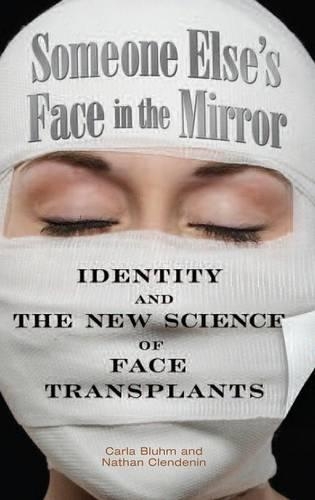
Книга Someone Else's Face in the Mirror: Identity and the New Science of Face Transplants
"Locating transplantation in the cultural imaginary-in the traditions of beauty, suffering, and the grotesque-Bluhm and Clendenin go beyond the details of medical procedures to show how a simple change of face implicates a profound social, moral, and historical turning point. Here is the inside story, a harrowing journey to love via borrowing and at the risk of rejection. What would it feel like to wake up looking like someone else? Is any face better than no face? ... Is the patient a victim-or even a guinea pig? How are mind and personality related to flesh? The polymath authors raise, comment on, and educate us about these and other critical issues with scholarly profundity, wisdom, accessibility, eminently good taste, and a citrus wit." -- Professor John Broughton Center for Educational Outreach and Innovation Columbia University "... in the history of surgery, there is no earlier operation that created so much controversy and triggered so much discussion as face transplantation... Beside the scientific debates, there is a world of psychological issues that this operation brings. In this book, the authors masterfully analyze the psychological meaning of face, with all the implications of how this novel operation impacts our society. The first cases of face transplantation, many still unknown to the public, are described with great detail. This is a remarkably well-written book that anyone fascinated by this topic will read in one sitting." -- Bohdan Pomahac, M.D. Plastic Surgeon, Brigham and Women's Hospital Harvard Medical School "Building on facial reconstruction techniques pioneered by surgeon Sir Harold Gillies in WWI, surgeons continue to struggle to reconstruct faces devastated by war. Someone Else's Face in the Mirror is the contemporary story of the most radical plastic surgery procedure ever attempted-a complete face transplant. Project Facade's empathy for the legacy of the servicemen treated by Gillies, is reflected in Bluhm and Clendenin's compassionate narrative. The authors outline the history and medical perspective of face transplants, and bring a healing spirit to those who receive face transplants, and a unique perspective to anyone who contemplates the complexities of their own identity." -- Paddy Hartley Artistic Director/Founder Project Facade "A serious and needed exploration of the traumatic impact of face transplants and how to support the hope this surgery provides. The authors pay special attention to war veterans, especially those disfigured in Iraq and Afghanistan, as well as individuals suffering disfigurement from a variety of causes. This book is creative and caring, opening insight into the sense of identity tied to the human face and problems one must engage in disfigurement and its amelioration. This book will help doctors, patients and all those interested in the vicissitudes of identity, injury and change." -- Michael Eigen, PhD Author, Feeling Matters and Flames From the Unconscious: Trauma, Madness and Faith Author, Feeling Matters and Flames From the Unconscious: Trauma, Madness and Faith.
In 2005, surgeons in France removed part of the face from a cadaver and grafted it onto the head of a 38-year-old woman grossly disfigured by a dog attack. Three years later, in December, 2008, surgeons at the Cleveland Clinic announced they had performed the first U.S. face transplant. Although modern culture is accustomed to pushing medicine and the human body beyond all limits, the world's first partial face transplant and the seven that have followed have caused a stir that still reverberates globally. This book begins with the story of Isabelle Dinoire, the recipient of the first face transplant, and chronicles her surgery and battles with tissue rejection. Its scope widens with a look at how surgical teams, including three U.S. transplant teams, are in a global race to perform the first full face transplant, and at how medical history has led up to this point—with prior successful transplants ranging from body parts as simple as cornea to those as neurologically complicated as the heart, a hand, and a penis. The most novel among these surgeries—the face transplant—conjures up particular and expansive psychological issues. Authors Bluhm and Clendenin show how transplant recipients struggle with functional issues including a lifetime of anti-rejection drugs, a danger highlighted by the recent death of the second face transplant patient, in China. But just as challenging in the case of face transplant is the psychological effect on—and potential threat to—identity. Who are you, if suddenly your face—or a significant portion of it—is not what you were born with? What is it like to look in the mirror, and see a face that is not the one you have always had? Dinoire lamented, "It will never be me." That statement is an absolute simplification of the identity issues a face transplant can create, explain the authors. Bluhm and Clendenin show how, across history and media, humankind—via medicine, literature, film, and other media—has dreamed of a day when face transplants would be possible. With so many disfigurements occurring among the military in Iraq, and experimental face transplants too expensive for implementation in the private sector, it is likely that the U.S. military will take the reins and further face transplant techniques as quickly as possible to serve injured personnel.
"While the clinical and historical aspects of the surgical procedures are aimed at medical professionals, general readers will appreciate the themes of identity, change and recovery." - SciTech Book News
"Someone Else's Face in the Mirror gives students, practitioners, and others the opportunity to think about identity from a different perspective. Psychopathology can cause major shifts in how people perceive themselves. Genetic disorders and other diseases can also affect self-perception. As faces lead people into every interpersonal contact, trauma that includes facial disfigurement increases the difficulty of treatment. Practitioners need to support medical treatments that improve a person's chance of a life that is suited to that person. Someone Else's Face in the Mirror allows professionals to grapple with an issue that might not come up otherwise and to form an opinion that each can then use to advocate for clients and patients. It also allows the reader to take a fresh look at how psychoanalytic theories can be expanded to explain and create interventions that treat and resolve physical and psychological trauma. That could then become the personal integration of innovative technique, trauma, and identity." - PsycCRITIQUES