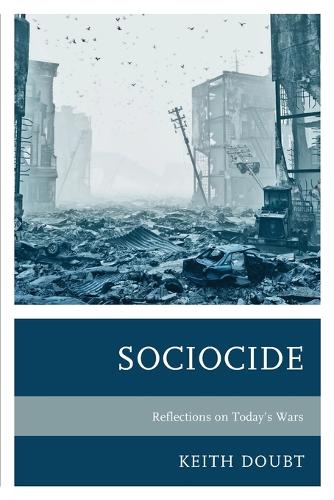
Книга Sociocide: Reflections on Today’s Wars
Wars have a destructive impact on society. The violence in the first case is domicide, in the second urbicide, in the third genocide, and in the fourth, the book introduces a neologism, sociocide, the killing of society. Through the lens of this neologism, Keith Doubt provides persuasive evidence of the social, political, and human consequences of today’s wars in countries such as Bosnia and Iraq. Sociocide: Reflections on Today’s Wars rigorously formulates, develops, and applies the notion of sociocide as a Weberian ideal type to contemporary wars. Drawing upon sociology, anthropology, philosophy, and literature, Doubt analyzes war crimes, scapegoating, and torture and concludes by examining capitalism in the face of the coronavirus pandemic as a sociocidal force. Embedded in the humanistic tradition and informed by empirical science, this book provides a clear conceptual account of today’s wars, one that is objective and moral, critical and humanistic.
"
The individual chapters in Sociocide are interdisciplinary in nature and cover a wide range of topics including the anthropology of burials, scapegoating, torture, pariahs, apologies, and the Coronavirus pandemic, taking the wars in Iraq and Bosnia and their consequences as persistent reference points. This reviewer found all the chapters fascinating, informative, and highly thought provoking, and is sure that other readers will too. The final chapter, based on the classical trinity of Karl Marx, Émile Durkheim, and Max Weber, will be particularly illuminating for sociologists. Given Doubt's theoretical preferences, Weber's anxiety, inducing consideration of charismatic "authority," perhaps holds the most relevance, especially considering the last US president and his "sociocidal" propensities.... [R]eading this book should be a highly fruitful and rewarding exercise for a great many people. Recommended.
" - Choice