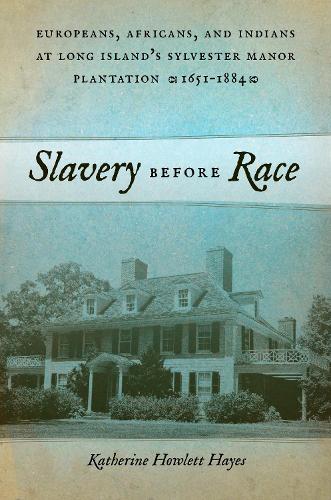
Книга Slavery before Race: Europeans, Africans, and Indians at Long Island's Sylvester Manor Plantation, 1651-1884
Addresses the significance of Sylvester Manor's plantation history to American attitudes about diversity, Indian land politics, slavery and Jim Crow, in tension with idealized visions of white colonial community
The study of slavery in the Americas generally assumes a basic racial hierarchy: Africans or those of African descent are usually the slaves, and white people usually the slaveholders. In this unique interdisciplinary work of historical archaeology, anthropologist Katherine Hayes draws on years of fieldwork on Shelter Island’s Sylvester Manor to demonstrate how racial identity was constructed and lived before plantation slavery was racialized by the legal codification of races.
Using the historic Sylvester Manor Plantation site turned archaeological dig as a case study, Hayes draws on artifacts and extensive archival material to present a rare picture of northern slavery on one of the North’s first plantations. The Manor was built in the mid-17th century by British settler Nathaniel Sylvester, whose family owned Shelter Island until the early 18th century and whose descendants still reside in the Manor House. There, as Hayes demonstrates, white settlers, enslaved Africans, and Native Americans worked side by side. While each group played distinct roles on the Manor and in the larger plantation economy of which Shelter Island was part, their close collaboration and cohabitation was essential for the Sylvester family’s economic and political power in the Atlantic Northeast. Through the lens of social memory and forgetting, this study addresses the significance of Sylvester Manor’s plantation history to American attitudes about diversity, Indian land politics, slavery and Jim Crow, in tension with idealized visions of white colonial community.
"Hayes makes the most of asking what is within and beyond the patterns other scholars have laid out. Her observations about the politics and culture of public memory involve scholars as agents of forgetting. Readers of Hayes's work will gain specific knowledge of early plantation slavery in the Northeast and also concrete lessons about being better students of the past." - William and Mary Quarterly
"Slavery before Raceshows the potential for archaeology to address the silences in the written record, and vice versa. It calls attention to a curious place in a region once thought to be homogenous, but that upon closer examination seems to have been full of heterogeneous curiosities. It reminds us that accounts of the past are so often overdetermined by present agendas." - American Historical Review
"This is one of the few studies on slavery in northern plantations and specifically plantations of the early New York, primarily before slavery was made into law . . . the author uses historical sources as well as material analysis to push beyond the argument of racial hierarchy on plantations. Instead, she explores the interplay of relationships, politics, social interactions, and identity that demonstrate more give and take and fluidity between the laborers, enslaves or otherwise, Indian and African, and their white owners, who were of Dutch heritage, as well as the members of the community of Shelter Island." - Choice
"Slavery before Race is an important book for students of African slavery, Native American history, and colonial history, as well as those interested in memory and the construction of historical narratives. It forces the historian to confront a number of implicit assumptions about the Northern plantation system, most notably the belief that Native Americans were irrelevant in such contexts. Hayes book also provides a useful corrective to the history of slavery in New York. Historians have long acknowledged and studied the importance of slavery in Dutch New Amsterdam and British New York City, although little has been written about African slavery in other regions of the New York colony.Slavery before Race provides a much-needed addition to the literature on slavery in lower New York. It also challenges the idea of race as a useful method of categorization of colonial laborers in the mid-seventeenth-century North. Finally, Hayes book reminds us that in the construction of historical narratives, what we forget, deliberately or accidentally, is often as important as what we choose to remember." - New York History
"Hayes study demonstrates the necessity of interdisciplinary understanding of historical archaeology, especially when it comes to studying populations underrepresented in the written record.Slavery before Racemakes the case for the persistent need to disentangle race from definitions of culture and community. . . . By drawing out the implications of her study for this contemporary debate, Hayes has reminded historians of race of the immediate importance of their work." - Journal of the Civil War Era
"She carefully dissects how historical memory is constructed, how some events and peoples are & successfully forgotten, and considers how memory functions socially. In her combination or archaeology, anthropology, oral history, and documentary evidence, she reminds readers that combing methodologies often yields a clearer rendering of the past. Hayes ambitious work will find a welcome home with scholars and others interested in community studies, the Atlantic world, early race formation, and memory studies." - Journal of American Ethnic History
"Ms. Hayes, an assistant professor of anthropology at the University of Wisconsin, approaches the story as someone who took part in the dig, using the artifacts discovered a well as the archival material in what is called historical archaeology to assess the relationship of the Sylvester family with their slaves, and Native Americans." - East Hampton Star
"One gets richly textured history only to the extent that one interrogates the evidence relentlessly and thoroughly, and only when one reassesses the actual data in light of the & official story. Hayes invites us to do that interrogation, and thus her volume is well worth reading, pondering, exploring analogous situations, and then re-reading." - Journal of African American History