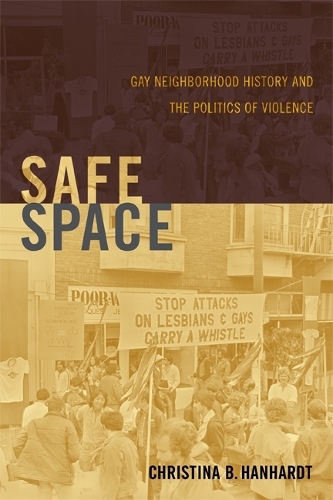
Книга Safe Space: Gay Neighborhood History and the Politics of Violence
A historical and ethnographic account of how LGBT activism for safe neighborhoods inadvertently dovetailed with and reinforced anticrime measures harmful to the poor and people of color.
Winner, 2014 Lambda Literary Award in LGBT Studies
Since the 1970s, a key goal of lesbian and gay activists has been protection against street violence, especially in gay neighborhoods. During the same time, policymakers and private developers declared the containment of urban violence to be a top priority. In this important book, Christina B. Hanhardt examines how LGBT calls for "safe space" have been shaped by broader public safety initiatives that have sought solutions in policing and privatization and have had devastating effects along race and class lines.
Drawing on extensive archival and ethnographic research in New York City and San Francisco, Hanhardt traces the entwined histories of LGBT activism, urban development, and U.S. policy in relation to poverty and crime over the past fifty years. She highlights the formation of a mainstream LGBT movement, as well as the very different trajectories followed by radical LGBT and queer grassroots organizations. Placing LGBT activism in the context of shifting liberal and neoliberal policies, Safe Space is a groundbreaking exploration of the contradictory legacies of the LGBT struggle for safety in the city.
"“This is a deep and intriguing study of what neighborhood and safety have meant—and seemed to mean—to different facets of the gay community at different times in its development in the period following WWII. . . . While obviously written for an academic audience, Safe Space will be accessible to most readers, and offers some insights into ways that gay spaces may not have been quite what we thought they were.”
" - Lit/Rant
"“A commendable revision of the LGBT story in America. . . . A dramatic picture of a febrile movement that had a difficult relationship with its competitors. The book further excels by demonstrating this history through the experiences of LGBT people of color, transgender individuals, and immigrants. This rich analysis serves as a useful primer on why gay neighborhoods are at the epicenter of discussions about gentrification.”" - Publishers Weekly
"“The book’s extensive coverage of LGBT activism in the latter half of the 20th century illustrates how contemporary socio-legal gains were made possible by resistance-fuelled, political organising. What began as a gay backlash to victimisation soon became a platform for resistance to state violence. . . . Overall, this is a fascinating insight into lesser-known aspects of America’s gay liberation movement.”" - Times Higher Education
"Hanhardt challenges commonly accepted narratives about safe streets, LGBT identity, and intersections of visibility and vulnerability. . . . Highly recommended. Upper-division undergraduates and above." - Choice
"Recommended both for its astute and never simplified analyses of social movements as well as its cautionarily optimistic political vision, Christina B. Hanhardt’s Safe Space is a necessary and welcome contribution to the field of LGBT and Queer Studies." - Sociological Review
"“Scholars and academics studying urban spaces, as well as grassroots activists within and outside the LGBT community, should take note of Hanhardt’s work. Her discussion of the emergence of LGBT activist claims to the protection of property and of self and the ways these protections became viewed as natural rights expected in American urban spaces helps illuminate not only specific transformations within urbanized LGBT populations in New York and San Francisco, but broader divisions which formed in liberal activist groups after the 1960s.”" - Planning Perspectives
"“Against the fractured landscape of cities characterized by uneven development, Safe Space is a clarion call for radicals to recognize the common deterrents facing all those working for more just cities. . . . Safe Space recognizes that claiming the city as an equitable space for all will require a broader understanding of identity, its use as a tool for development, and its latent potential as a site of resistance.”" - Jacobin
"“Hanhardt’s voice is that of an activist saddened, sometimes enraged, by how the potential for both equality and diversity was squandered by a middle-class white gay movement. Her book, then, is itself a moral intervention, one that combines social research and utopian politics.”" - Public Books
"“Safe Space is a richly researched examination of activist organizations and less-organized activist efforts on behalf of LGBT rights in San Francisco and New York over the last fifty years. Hanhardt draws on archival materials as well as interviews and participant observation to provide a view that is close to the ground, attentive to the trees, even sometimes the weeds, without losing view of the forest.”" - GLQ
"“Safe Space is impressive in its research and scope. . . . Safe Space is indispensable reading for anyone interested in the intersections of LGBT history, critical race and sexuality studies, and urban studies.”" - Journal of American History
"Hanhardt’s Safe Space offers an activist historiography of urban redevelopment and displacement, where biopolitical shifts have carved the social and physical landscape of San Francisco and New York City from the 1960s to the present.... She skillfully manages a dance of scale—telling both a macro history of changing postwar American liberalism and the micro histories of the ways it all came to remake daily life." - QED