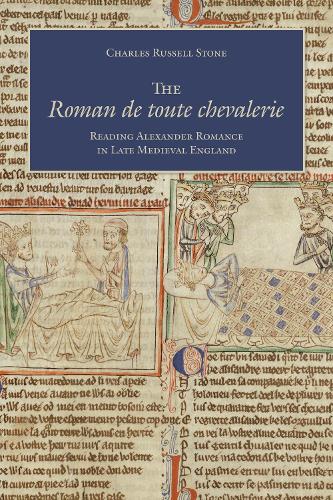
The medieval reception of Alexander the Great inspired a complicated literary corpus not simply because it involved so many source-texts and languages, but because it incorporated such diverse perspectives on the conqueror. Beginning with a discussion of the evolution of this corpus, this book examines the manuscripts, readership, and historical contexts of the earliest surviving Alexander romance in England, Thomas de Kent’s Anglo-Norman Roman de toute chevalerie.
To shed light on the origins and treatment of this romance, Charles Russell Stone reads each manuscript within the contexts of its production, scribal interpolations, and patronage and readership in the thirteenth and fourteenth centuries. While Thomas recalls a range of attitudes towards his protagonist in the late twelfth century, when the recovery of classical histories and composition of vernacular romance informed conflicting attitudes towards Alexander’s legacy, scribes and readers of his poem appropriated it as a continuing commentary on power, politics, and the relevance of the Alexander legend in their own time. Each of the three major manuscripts of Thomas’s poem thus offers a unique text informed by unique literary and political contexts, which this book situates within the ongoing debate over Alexander’s reception as a paradigm of imperial authority or failure in late medieval England.
"
"Stone’s monograph is grounded in historicism and lively in its address to English social constituencies (baronial, regnal, clerical, courtly-dynastic). It opens the door to further investigation of an understudied but central work, and will be of interest to scholars of romance, text-networks, insular literary history, and codicology."
" -
Studies in the Age of Chaucer