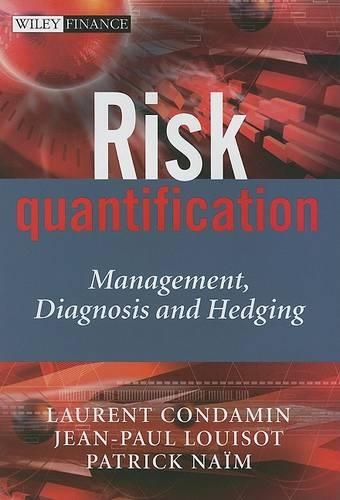
Книга Risk Quantification: Management, Diagnosis and Hedging
This book offers a practical answer for the non-mathematician to all the questions any businessman always wanted to ask about risk quantification, and never dare to ask.
Enterprise-wide risk management (ERM) is a key issue for board of directors worldwide. Its proper implementation ensures transparent governance with all stakeholders’ interests integrated into the strategic equation. Furthermore, Risk quantification is the cornerstone of effective risk management,at the strategic and tactical level, covering finance as well as ethics considerations. Both downside and upside risks (threats & opportunities) must be assessed to select the most efficient risk control measures and to set up efficient risk financing mechanisms. Only thus will an optimum return on capital and a reliable protection against bankruptcy be ensured, i.e. long term sustainable development.
Within the ERM framework, each individual operational entity is called upon to control its own risks, within the guidelines set up by the board of directors, whereas the risk financing strategy is developed and implemented at the corporate level to optimise the balance between threats and opportunities, systematic and non systematic risks.
This book is designed to equip each board member, each executives and each field manager, with the tool box enabling them to quantify the risks within his/her jurisdiction to all the extend possible and thus make sound, rational and justifiable decisions, while recognising the limits of the exercise. Beyond traditional probability analysis, used since the 18th Century by the insurance community, it offers insight into new developments like Bayesian expert networks, Monte-Carlo simulation, etc. with practical illustrations on how to implement them within the three steps of risk management, diagnostic, treatment and audit.
With a foreword by Catherine Veret and an introduction by Kevin Knight.
"Risk Quantification" ist das bislang einzige Buch auf dem Markt, das eine aktuelle und umfassende Betrachtung des Bereiches Risikomanagement bietet, wobei der Schwerpunkt klar auf der Quantifizierung von Risiken und weniger auf dem reinen Management liegt. Es vermittelt ein fundiertes Verständnis der zur Ermittlung des Risikopotenzials einsetzbaren Tools. Dabei geht es sowohl um die Quantifizierung des Risikos als auch um die Wahrscheinlichkeit des Risikoereignisses, seine Häufigkeit und Eintrittswahrscheinlichkeit. Der Band gliedert sich in drei Teile. Teil 1 beschreibt die Grundlagen des Risikomanagement als einen dreistufigen Prozess - Diagnose, Verminderung und Finanzierung des Risikos - und demonstriert, warum die Quantifizierung (Messung, Bewertung und Analyse) von Risiken in allen Phasen des Prozesses so wichtig ist. Der Schwerpunkt liegt klar auf der praktischen Herangehensweise an das Problem und weniger auf statistischen Analyseverfahren.Teil 2 stellt ein bewährtes Toolset zur Risikoquantifizierung vor, erläutert sog. Score Cards zur Bewertung wichtiger Risikoindikatoren sowie Monte Carlo Simulation und Bayesianische Netze als Quantifizierungsansatz für die Risikomodellierung.
Teil 3 demonstriert dann anschaulich anhand von Fallstudien, wie das Toolset auf die drei Stufen des Risikomanagement in der Praxis angewendet wird.