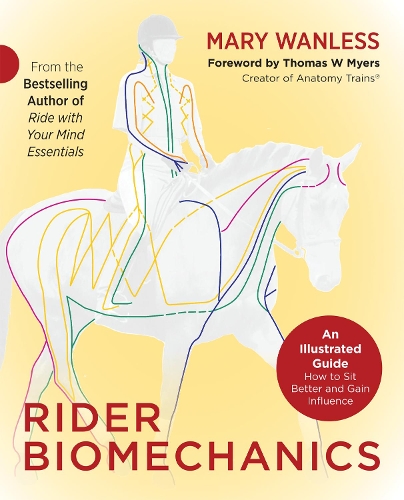
Rider Biomechanics begins by explaining fascia — the 'cinderella of body tissues'. Until recently, this was ignored by science, consigned to its apparent role as the body's packing material. However, research shows that, in reality, this biological fabric links muscles into functional chains, rather like strings of sausages.
Recent research has shown that the horse's fascial system is remarkably similar to our own, with equivalent 'lines of pull' that affect posture, movement, stability and mobility. Inevitably, the problems inherent in sitting and riding well are magnified when there is imbalance within and between the fascial 'guy-ropes' of rider and/or horse. We should realise that imbalance in either partner can send the other 'out of true', whilst the 'equipoise' of one partner helps the other to regain that poise.
By working through this book, you will learn to access and rebalance your own fascial net to significantly improve your stability, skill and 'feel'. Practical exercises, enhanced with copious photographs and diagrams, show how to balance your front and back, left and right — yielding skills that simultaneously address the equivalent imbalances in your horse.
Mary explains how effective force transmission within the fascial system enables riders to push their hands forward, taking away the temptation to pull on the reins. Later chapters show how twists and distortions in both human and horse can be addressed through accessing the fascial lines that wrap diagonally around the body. Lastly, a look at the core of both partners shows just how profound their connection can be.
"Mary Wanless – who's extremely well-known for her previous books dedicated to rider position (Ride With Your Mind) – has put more of her knowledge and training onto the pages or Rider Biomechanics... In some ways, she tells us, it can rather like the skin on a string of sausages – the fascia that is the fabric of our body, that is then the link into muscle and functional chains. 'Lines of pull'. Where the horse is concerned, these lines of pull are what we as riders, need to be aware of... Sounds simple here, but whether you tip forward, tip back, round your back or hollow it, draw your leg upwards, forwards or too far back, there is a complete explanation and reasoning behind it, through it and then working towards correcting it.
With disciplined training – we can all edge towards riding and looking as it we're sitting elegantly, not doing a lot!
" - Essex Rider