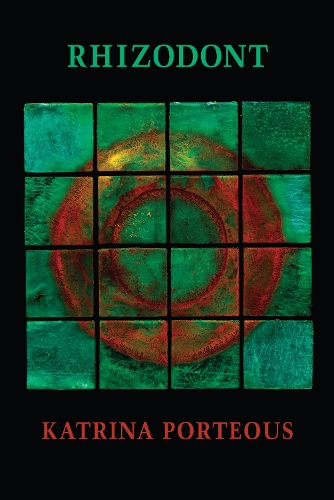
Книга Rhizodont
330 million years ago what is now the rocky shore close to Katrina Porteous’s Northumberland home was a tropical swamp inhabited by three-metre long predatory fish with huge tusk-like teeth. They belonged to a family of lobe-finned fishes which evolved to move on land as well as swim, and which are the ancestors of all four-limbed vertebrates, including humans. The fossil fish found in Northumberland is called the ‘rhizodont’.
Porteous’s new collection begins with a lovingly-observed contemporary journey through these ancient landscapes, from the former coal-mining communities of the Durham coast, where the coal-bearing Carboniferous strata are overlain with younger rocks, to the Northumberland shores where the rhizodont’s remains were found. Against a backdrop of vast geological time and recent fossil-fuel burning history, these poems address current issues of social and environmental change. They are followed by two sequences about aspects of the latest technological revolution – autonomous systems and AI, and the remote-sensing techniques used to explore the most inaccessible reaches of our planet, Antarctica, to measure Earth’s changing climate.
The poems unfold from England’s North-East coast into global questions of evolution, survival and extinction – in communities and languages, and throughout the natural world, where hope resides in Life’s astonishing powers of reinvention.
Rhizodont is Katrina Porteous's fourth poetry collection from Bloodaxe, and extends territory explored in her three previous books. It combines scientific themes from Edge (2019) with the ecological localism of Two Countries (2014) and The Lost Music (1996), both of which were concerned with the landscapes and communities of North-East England.
"Functioning like a cosmic map from the level of sub-atomic particles to vast celestial bodies, Edge succeeds in wedding the arts with science to make a mesmerising and transporting collection. Porteous makes precise and artful use of scientific terminology to complement her sparse and tightly constructed verse. The full effect is to bring the reader to a state of communion; to instil a sense of beauty and belonging to the world of particles, fields, waves, and the behaviour of massive gravitational bodies." - PBS Bulletin
"Regardless of their performance roots, I found the poems in Edge to be strong, evocative pieces exploring the cosmos and the creation of matter and life vibrantly and distinctively through image, metaphor and all the tools available to a skilled poet. The fact that, stylistically, they often appear lean and pared down makes their lyrical imagining of highly complex scientific theories all the more impressive." - The High Window