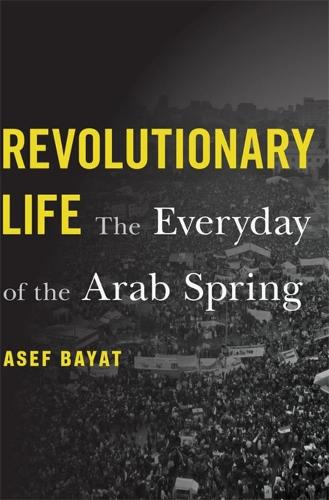
Книга Revolutionary Life: The Everyday of the Arab Spring
From a leading scholar of the Middle East and North Africa comes a new way of thinking about the Arab Spring and the meaning of revolution.
From the standpoint of revolutionary politics, the Arab Spring can seem like a wasted effort. In Tunisia, where the wave of protest began, as well as in Egypt and the Gulf, regime change never fully took hold. Yet if the Arab Spring failed to disrupt the structures of governments, the movement was transformative in farms, families, and factories, souks and schools.
Seamlessly blending field research, on-the-ground interviews, and social theory, Asef Bayat shows how the practice of everyday life in Egypt and Tunisia was fundamentally altered by revolutionary activity. Women, young adults, the very poor, and members of the underground queer community can credit the Arab Spring with steps toward equality and freedom. There is also potential for further progress, as women’s rights in particular now occupy a firm place in public discourse, preventing retrenchment and ensuring that marginalized voices remain louder than in prerevolutionary days. In addition, the Arab Spring empowered workers: in Egypt alone, more than 700,000 farmers unionized during the years of protest. Labor activism brought about material improvements for a wide range of ordinary people and fostered new cultural and political norms that the forces of reaction cannot simply wish away.
In Bayat’s telling, the Arab Spring emerges as a paradigmatic case of “refolution”—revolution that engenders reform rather than radical change. Both a detailed study and a moving appeal, Revolutionary Life identifies the social gains that were won through resistance.
"Bayat, a sociologist and an acute chronicler of everyday life in the Middle East and North Africa, explores the fate of marginalized people in the uprisings of the Arab Spring." - Foreign Affairs
"Stands out…for its brilliance and lack of sentimentality…Focusing on Egypt and Tunisia, Bayat’s argument is that the events of 2011 set something radical in motion and imposed a new set of social relations onto everyday life. The book is rich with examples of this everyday resistance from both countries." - Jacobin
"Pioneers an important topic…By diving deeper into overlooked and marginal groups, Bayat reveals the dynamics of ordinary people disregarding individual ideals and participating in something exceptional. Revolutionary Life is a study of the ordinary that is anything but." - Middle East Quarterly
"[Bayat] has been a sure-footed observer of revolutions for decades…Although the Arab revolts appear to have largely failed, Bayat argues that even revolutions that do not reach the pinnacle of power leave behind lasting change." - Survival: Global Politics and Strategy