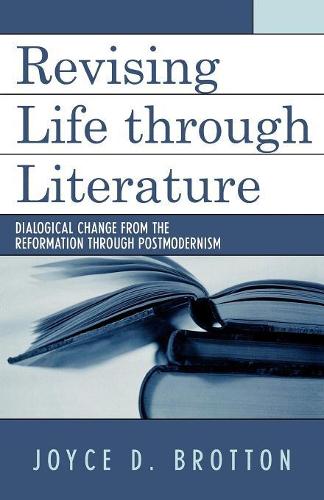
Книга Revising Life Through Literature: Dialogical Change from the Reformation through Postmodernism
After the Reformation, science superseded both religion and literature as the favored source of knowledge. As people became free of a catechism of rote responses, they found the concept of self-determination both liberating and terrifying. Literature stepped in by providing examples of fictional characters that made choices in circumstances similar to the quandaries faced by readers—situations that could not be easily resolved by scripture alone. As a critical theory, dialogism makes our literary heritage germane. It offers a strategy for readers to improve their immediate lives through literary insights. It also offers a means to employ literary theory to reveal overlooked clues and lingering inhibitions embedded in past literature that can affect the reader's present life. In Revising Life Through Literature: Dialogical Change from the Reformation through Postmodernism, Joyce Brotton cites topical examples of the past several centuries to argue the relevancy of literary works to everyday existence. Each chapter opens with a philosophical background that identifies conflict arising from a dichotomy between religion and science, followed by a literary discussion of works that respond to the needs of that age. Included in her discussion are King Lear, The Duchess of Malfi, Paradise Lost, Candide, Wuthering Heights, and Adam Bede. More recent examples include James Joyce's Ulysses, John Fowles' The French Lieutenant's Woman, Julian Barnes' The History of the World in 10 1/2 Chapters, and Margaret Atwood's The Blind Assassin. This book is more than a teaching vehicle; it focuses on the parallel power of the imagination to create situations that may not reflect exactly the reader's own needs, but can boost confidence by offering a range of options for coping with life. This absorbing, entertaining, and informative resource encourages readers to use literature for relevancy rather than as a mere distraction.
"When science superseded both religion and literature as the favored source for knowledge, most people were at a loss for practical and theoretical guidance in daily life. Brotton (English, Northern Virginia Community College) examines how literature rebounded by supplying characters making the same difficult decisions as were readers, and both making those decisions bereft of religion. Brotton works through a range of works, including King Lear, The Duchess of Malfi, Paradise Lost, Candide, Wuthering Heights and Adam Bede, with modern references in Ulysses, The French Lieutenant's Woman and works by Barnes and Atwood." - Reference and Research Book News, August 2006