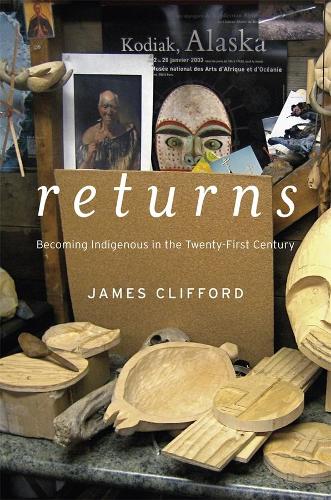
Книга Returns: Becoming Indigenous in the Twenty-First Century
Returns explores homecomings—the ways people recover and renew their roots. Engaging with indigenous histories of survival and transformation, James Clifford opens fundamental questions about where we are going, separately and together, in a globalizing, but not homogenizing, world.
It was once widely assumed that native, or tribal, societies were destined to disappear. Sooner or later, irresistible economic and political forces would complete the work of destruction set in motion by culture contact and colonialism. But many aboriginal groups persist, a reality that complicates familiar narratives of modernization and progress. History, Clifford invites us to observe, is a multidirectional process, and the word “indigenous,” long associated with primitivism and localism, is taking on new, unexpected meanings.
In these probing and evocative essays, native people in California, Alaska, and Oceania are understood to be participants in a still-unfolding process of transformation. This involves ambivalent struggle, acting within and against dominant forms of cultural identity and economic power. Returns to ancestral land, performances of heritage, and maintenance of diasporic ties are strategies for moving forward, ways to articulate what can paradoxically be called “traditional futures.” With inventiveness and pragmatism, often against the odds, indigenous people today are forging original pathways in a tangled, open-ended modernity. The third in a series that includes The Predicament of Culture (1988) and Routes (1997), this volume continues Clifford’s signature exploration of late-twentieth-century intercultural representations, travels, and now returns.
"In writing about aboriginal peoples, Clifford aims to challenge the apparently simple, exposing proofs of persistence and resilience where others might resort to elegy." - Times Literary Supplement
"Returns tracks the multiple and numerous narratives involved in this reconceptualization of what it means to be ‘indigenous’ or ‘native’ in the cosmopolitan twenty-first century… Returns brings new forms of analysis and perspectives to these debates owing to its fresh consideration of cosmopolitanism and (post)modernity and the impact of these upon indigeneity… Returns is of potential interest to a range of readers—both those interested in the anthropology of social movements but also scholars of knowledge and intellectual history… Thoughtful and fascinating." - LSE Review of Books
"Clifford brings together processes and phenomena that are commonly regarded as antithetical—specifically, modernity and native peoples. His is a detailed analysis of the connections and multidimensional cultural relationships linking places and people far and near… While native societies have indeed suffered, many flourished in an increasingly interconnected world, a culturally and demographically positive trend. Global in scope and covering much ground, the book celebrates and explains the resurgence of subordinated societies ranging from Pacific Islanders to Native Americans, and discusses cultural renewal among the Maya as well as the cultural and political aspirations of Catalonia." - Choice
"Clifford deftly examines two major themes—globalization and decolonization—and their complex impact on native lives… Clifford successfully interweaves ideas from multiple disciplines including anthropology, sociology, history, and political science to create a fascinating cultural exploration." - Library Journal