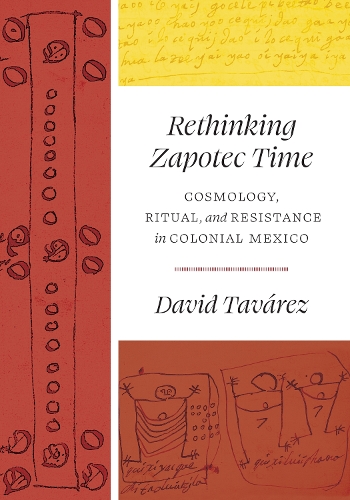
Книга Rethinking Zapotec Time: Cosmology, Ritual, and Resistance in Colonial Mexico
2023 — Best Subsequent Book — Native American and Indigenous Studies Association
2023 — Honorable Mention, Best Book in the Social Sciences — Latin American Studies Association, Mexico Section
2022 — Marysa Navarro Best Book Prize — New England Council of Latin American Studies
2023 — Honorable Mention, LASA Mexico Social Sciences Book Prize — Mexico Section, Latin American Studies Association (LASA)
As the first exhaustive translation and analysis of an extraordinary Zapotec calendar and ritual song corpus, seized in New Spain in 1704, this book expands our understanding of Mesoamerican history, cosmology, and culture.
In 1702, after the brutal suppression of a Zapotec revolt, the bishop of Oaxaca proclaimed an amnesty for idolatry in exchange for collective confessions. To evade conflict, Northern Zapotec communities denounced ritual specialists and surrendered sacred songs and 102 divinatory manuals, which preserve cosmological accounts, exchanges with divine beings, and protocols of pre-Columbian origin that strongly resemble sections of the Codex Borgia. These texts were sent to Spain as evidence of failed Dominican evangelization efforts, and there they remained, in oblivion, until the 1960s.
In this book, David Tavárez dives deep into this formidable archive of ritual and divinatory manuals, the largest calendar corpus in the colonial Americas, and emerges with a rich understanding of Indigenous social and cultural history, Mesoamerican theories of cosmos and time, and Zapotec ancestor worship. Drawing on his knowledge of Zapotec and Nahuatl, two decades of archival research, and a decade of fieldwork, Tavárez dissects Mesoamerican calendars as well as Native resistance and accommodation to the colonial conquest of time, while also addressing entangled transatlantic histories and shining new light on texts still connected to contemporary observances in Zapotec communities.
"Rethinking Zapotec Time is an enormous accomplishment [that] will become an important element of graduate education, and a building block for new research ... David Tavárez, a formidable historian and linguist of colonial-era Zapotec and Nahuatl, brings us a book that is informed by two decades of work [which] contributes to ongoing discussions about the interaction of missionary Catholicism with traditional indigenous beliefs . . . To a non-specialist such as the current reviewer (who reads neither Nahuatl nor Zapotec), this book is a powerful demonstration of the back-breaking labor undertaken by peers in the field of Mesoamerican philology. For the specialists themselves, I expect Rethinking Zapotec Time will become an important element of graduate education, and a building block for new research." - International Journal of Latin American Religions
"
David Tavárez is one of the first [researchers] to emphasize the importance of the intellectual production of Indigenous people in their own language, and ... at last, a long-awaited monograph has been published, one that is the result of a notably complex and lengthy research project, carried out over more than 20 years ... The book contains eight chapters, each of which is practically a monograph about a concrete theme or question.
David Tavárez ha sido de los primeros en destacar la importancia de la producción intelectual indígena en su propia lengua, y ... se publica por fin una monografía largamente esperada, fruto de un proyecto de investigación de largo aliento y notable complejidad, llevado a cabo a lo largo de más de 20 años... El libro se compone de 8 capítulos, cada uno de los cuales es prácticamente una monografía sobre una temática o problemática concreta.
" - Revista de Indias