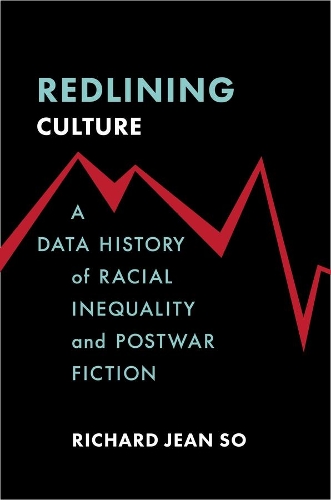
Книга Redlining Culture: A Data History of Racial Inequality and Postwar Fiction
The canon of postwar American fiction has changed over the past few decades to include far more writers of color. It would appear that we are making progress—recovering marginalized voices and including those who were for far too long ignored. However, is this celebratory narrative borne out in the data?
Richard Jean So draws on big data, literary history, and close readings to offer an unprecedented analysis of racial inequality in American publishing that reveals the persistence of an extreme bias toward white authors. In fact, a defining feature of the publishing industry is its vast whiteness, which has denied nonwhite authors, especially black writers, the coveted resources of publishing, reviews, prizes, and sales, with profound effects on the language, form, and content of the postwar novel. Rather than seeing the postwar period as the era of multiculturalism, So argues that we should understand it as the invention of a new form of racial inequality—one that continues to shape the arts and literature today.
Interweaving data analysis of large-scale patterns with a consideration of Toni Morrison’s career as an editor at Random House and readings of individual works by Octavia Butler, Henry Dumas, Amy Tan, and others, So develops a form of criticism that brings together qualitative and quantitative approaches to the study of literature. A vital and provocative work for American literary studies, critical race studies, and the digital humanities, Redlining Culture shows the importance of data and computational methods for understanding and challenging racial inequality.
"In this gift of a book, So challenges racial hegemony and discrimination in the publishing industry — and, by extension, in the country at large . . . Recognizing the significance of So’s work means recognizing the impact of words, language, and storytelling on who we have been as a country, who we are as a country, and who we could be as a country if we valued, amplified, and embraced the stories of those from historically marginalized groups — an embrace that, ultimately, would shape a world built upon celebrating not only their stories and voices, but their lives." - Los Angeles Review Books
"Redlining Culture joins a select group of texts in the humanities that employ scientific tools and computational methods in order to rigorously demonstrate the existence and persistence of institutional injustices . . . [This book] levels an incisive, evidence-based criticism against the American publishing industry, as well as the academic discipline of literary and cultural studies." - Publishing Research Quarterly
"Using an incisive combination of data science and traditional literary scholarly methods, So paints a compelling picture of the persistence of whiteness in literary culture, analysing the whole cycle of literary production to uncover the ways in which power moves through the system . . . Redlining Culture: A Data History of Racial Inequality and Postwar Fiction shows the richness arising from the application of an intersectional, data-justice-informed approach to a set of questions about literary culture." - The Year’s Work in Critical and Cultural Theory: Digital Humanities
"At its best moments, So’s methodologies are indeed able to document the way that our institutions of publishing, book reviewing, and scholarly criticism have ossified or reified racialized entities like the ‘Black Author’ or ‘Asian American Fiction’ both as market phenomena and on the page." - The Year’s Work in Critical and Cultural Theory: Economic Criticism
"[So] is a clear and thoughtful writer, and this is particularly helpful to those new to big data and machine learning." - College & Research Libraries