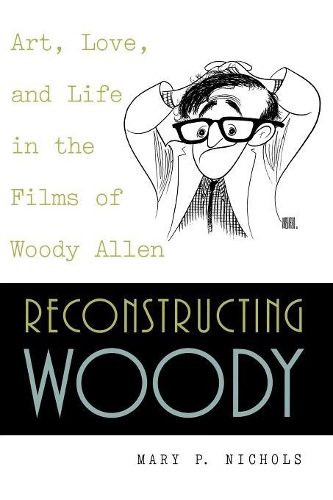
Книга Reconstructing Woody: Art, Love, and Life in the Films of Woody Allen
For too long, the films of Woody Allen have been interpreted as expressions of deconstructionism, nihilism, and postmodern angst. In this pathbreaking new book, distinguished writer Mary P. Nichols challenges these assumptions by arguing that Allen's entire body of work, from Play It Again, Sam to Mighty Aphrodite, is actually an attempt to explore and reconcile the tension between art and life. As witty and complex as its subject, Reconstructing Woody shows why Allen, despite his recent personal turmoil, is immensely concerned with human ethics, goodness, and virtue. Ardent fans and strident detractors will view Woody Allen's films from an entirely new perspective.
"What began as a diversion provoked a larger revelation. In both works Nichols discovered a writer mocking the pretensions of philosophers whose words prove to be empty as, well, clouds. Is this similarity enough to make Manhattan's Allen a modern-day Aristophanes? Her focus is always on Allen the filmmaker and never on Allen the home-wrecker. More importantly, it is her conviction that Allen's real on-screen preoccupation is not his sex-life, but the interrelationships between art and life." - Crisis, March 1999
"Miss Nichols' approach to the topic of Woody Allen is peculiar, as she is a professor of political science, not film studies. What she brings to Mr. Allen's films is a way of thinking and analyzing that is unavailable to the run-of-the-mill film studies professor or critic." - The Washington Times
"Is full of valuable insights, especially in the way it examines the philosophical nature of a number of Woody Allen's films. Offers the reader a strong foundation on which to build an understanding of Allen and his work." - Rocky Mountain Review
"All film collections should include this title." - CHOICE
"What began as a diversion provoked a larger revelation. In both works Nichols discovered a writer mocking the pretensions of philosophers whose words prove to be empty as, well, clouds. Is this similarity enough to make Manhattan's Allen a modern-day Aristophanes? Her focus is always on Allen the filmmaker and never on Allen the home-wrecker. More importantly, it is her conviction that Allen's real on-screen preoccupation is not his sex-life, but the interrelationships between art and life." - Crisis, March 1999