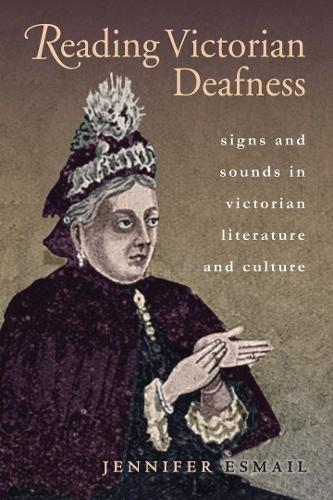
Книга Reading Victorian Deafness
Reading Victorian Deafness is the first book to address the crucial role that deaf people, and their unique language of signs, played in Victorian culture.
Reading Victorian Deafness is the first book to address the crucial role that deaf people, and their unique language of signs, played in Victorian culture. Drawing on a range of works, from fiction by Charles Dickens and Wilkie Collins, to poetry by deaf poets and life writing by deaf memoirists Harriet Martineau and John Kitto, to scientific treatises by Alexander Graham Bell and Francis Galton, Reading Victorian Deafness argues that deaf people’s language use was a public, influential, and contentious issue in Victorian Britain.
The Victorians understood signed languages in multiple, and often contradictory, ways: they were objects of fascination and revulsion, were of scientific import and literary interest, and were considered both a unique mode of human communication and a vestige of a bestial heritage. Over the course of the nineteenth century, deaf people were increasingly stripped of their linguistic and cultural rights by a widespread pedagogical and cultural movement known as “oralism,” comprising mainly hearing educators, physicians, and parents.
Engaging with a group of human beings who used signs instead of speech challenged the Victorian understanding of humans as “the speaking animal” and the widespread understanding of “language” as a product of the voice. It is here that Reading Victorian Deafness offers substantial contributions to the fields of Victorian studies and disability studies. This book expands current scholarly conversations around orality, textuality, and sound while demonstrating how understandings of disability contributed to Victorian constructions of normalcy. Reading Victorian Deafness argues that deaf people were used as material test subjects for the Victorian process of understanding human language and, by extension, the definition of the human.
"“[A] truly excellent, original book that deserves to be widely read… Reading Victorian Deafness is an astonishing contribution not only to disability studies but also to the many uses to which the shifting relations between sound and print were put in nineteenth-century literature and culture.”" - SEL: Studies in English Literature, 1500-1900
"“Appealing to a wide range of academic audiences, Esmail's monograph is an authoritative and thought-provoking study that encourages its readers to reconsider the significance of the spoken language in terms of what it means to be human.”" - Literature & History
"“(Reading Victorian Deafness) offers a richer demonstration of how Victorian deafness might make us think. As a truly comprehensive study of Victorian deafness, it incrementally expands the scope of disability studies theory and practice by clearly synthesizing disability studies with other subdisciplines, thus building innovative new frameworks for investigating the cultural history of the body.”" - Review 19