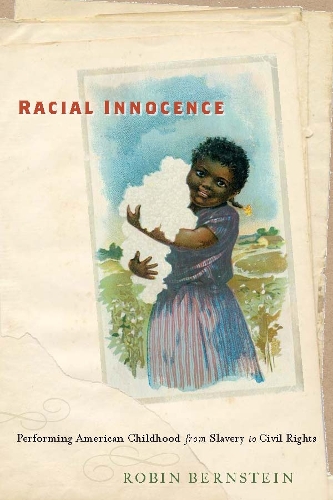
Книга Racial Innocence: Performing American Childhood from Slavery to Civil Rights
Shows how the concepts of childhood innocence fundamentally shaped the history of race in the US
2013 Book Award Winner from the International Research Society in Children's Literature
2012 Outstanding Book Award Winner from the Association for Theatre in Higher Education
2012 Winner of the Lois P. Rudnick Book Prize presented by the New England American Studies Association
2012 Runner-Up, John Hope Franklin Publication Prize presented by the American Studies Association
2012 Honorable Mention, Distinguished Book Award presented by the Society for the Study of American Women Writers
Dissects how "innocence" became the exclusive province of white children, covering slavery to the Civil Rights era
Beginning in the mid nineteenth century in America, childhood became synonymous with innocence—a reversal of the previously-dominant Calvinist belief that children were depraved, sinful creatures. As the idea of childhood innocence took hold, it became racialized: popular culture constructed white children as innocent and vulnerable while excluding black youth from these qualities. Actors, writers, and visual artists then began pairing white children with African American adults and children, thus transferring the quality of innocence to a variety of racial-political projects—a dynamic that Robin Bernstein calls “racial innocence.” This phenomenon informed racial formation from the mid nineteenth century through the early twentieth.
Racial Innocence takes up a rich archive including books, toys, theatrical props, and domestic knickknacks which Bernstein analyzes as “scriptive things” that invite or prompt historically-located practices while allowing for resistance and social improvisation. Integrating performance studies with literary and visual analysis, Bernstein offers singular readings of theatrical productions from blackface minstrelsy to Uncle Tom’s Cabin to The Wonderful Wizard of Oz; literary works by Joel Chandler Harris, Harriet Wilson, and Frances Hodgson Burnett; material culture including Topsy pincushions, Uncle Tom and Little Eva handkerchiefs, and Raggedy Ann dolls; and visual texts ranging from fine portraiture to advertisements for lard substitute. Throughout, Bernstein shows how “innocence” gradually became the exclusive province of white children—until the Civil Rights Movement succeeded not only in legally desegregating public spaces, but in culturally desegregating the concept of childhood itself.
"Bernstein's text unfolds with a readerly pleasure few scholarly books achieve, as she offers stunning close readings while steadily constructing a compelling narrative arc built upon each piece of evidence." - Legacy
"Bernstein offers a new perspective by exploring not only what artifacts reveal but also what they demand." - Journal of American Culture
"Racial Innocence is an invaluable contribution. . . it enlivens a diverse constellation of evidence, making it an exemplary model for any interdisciplinary project of similarly ambitious scope." - Journal of Popular Culture
"[T]antalizing [W]ith ethical finesse and theoretical dexterity, Bernsteins book explores. . . the extent to which our national reality has been a topsy-turvy one from the start." - Theatre Survey
"A historiographic tour de force . . . Her rich archive and nuanced analysis will make this a classic book for theater historians and performance theorists." - The Outstanding Book Award prize committee, Association for Theatre in Higher Education
"A paradigm-shifting study of major significance." - The Journal of American Studies
"A powerhouse of a book. . . [an] intervention of the highest order. Racial Innocencewill quickly become a cornerstone text in many fields, ranging from critical race theory and performance studies to American cultural history and childhood studies." - Journal of Dramatic Theory and Criticism
"A provocative, insightful, and bold text that demonstrates how important the field of cultural studies is and can be." - Jeunesse: Young People, Texts, Cultures
"Arresting. . . shows how the hegemonic project of white supremacy takes constant reinforcement in popular forms to naturalize racist practices on the ground." - Callaloo
"Bernstein masterfully balances important theoretical and methodological interventions alongside insightful analysis of everyday material." - Callaloo
"Bernstein's book will be of keen interest to those working to study either childhood or toy culture in the United States, as well as to scholars of critical race theory or postcolonial studies." - Cultural Studies
"Daringly imaginative." - International Research for Children’s Literature
"Dazzling incredibly moving." - American Quarterly
"Far-reaching... important." - Genre
"Fresh and astonishing." - Theatre Journal
"Groundbreaking . . . radical." - Theatre Annual
"Impressively researched, cogently written, and deeply theorized. . . . [Bernstein shows how] harmless, innocent fun (as evidenced in an astonishing chapter on the minstrel roots of Raggedy Ann and Andy) became a disavowed site for the reproduction of white supremacy. . . . [M]akes an understated but highly persuasive case for the contribution of a historically-oriented performance studies to the interdisciplinary conversations surrounding the politics of the everyday." - Theatre History Studies
"Intellectual espresso." - Is That Your Child?
"Intellectually exhilarating." - The Journal of the History of Childhood and Youth
"It is original, theoretically challenging, and adds fundamentally new insights to the history of childhood." - Prize Committee, Grace Abbott Best Book Award, Society for the History of Childhood and Youth
"Magnificent and stylish truly groundbreaking." - The Lion and the Unicorn
"One of those rare books that shifts the paradigm--a book that, in years to come, will be recognized as a landmark in children's literature and childhood studies . . . This is not one of those scholarly books that offer a thesis and then proceed to pummel the reader into submission by piling example on top of example. Instead, it develops a certain line of argument, and then turns, moving in a different direction, developing this new direction fully before changing tack once more. Structuring the argument this way makes for a much more interesting reading experience . . . [F]ew scholars can write a sentence like Bernstein can: packed with insight, theoretically sophisticated, and yet lucid--even, at times, lyrical..." - Children's Literature
"Remarkably impressive. . . . Bernstein surprises us with the fractures we know." - Modern Drama
"Revelatory." - MELUS: Multi-Ethnic Literature of the US
"Richly researched, inspiring in its analysis of archival material, and impressive in its deft ability to traverse disciplinary borders, including childhood studies, performance studies, literary studies, and American history. . . . Poignant. . . Bernsteins superb text hauntingly prompts the reader to consider where invocations of childhood are being used in contemporary US racial formation. At a time when black childhood performances have been front and center in American media discoursefor example, the circulating images of Trayvon Martin that were used to simultaneously evidence both the teenage innocent and the future-adult-thugRacial Innocencerequires the contemporary reader to resist feigning holy obliviousness" to the ways in which racial arguments can be cloaked in children and their toys." - TDR: The Drama Review
"Riveting." - Children's Literature Association Quarterly
"Vibrant. . . [An] exemplary model of interdisciplinary scholarship." - African American Review
"You will never look at a Raggedy Ann doll the same way again." - Backlist