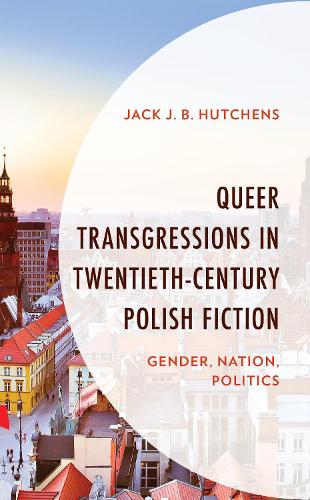
Книга Queer Transgressions in Twentieth-Century Polish Fiction: Gender, Nation, Politics
Throughout the twentieth century in Poland various ideologies attempted to keep queer voices silent—whether those ideologies were fascist, communist, Catholic, or neo-liberal. Despite these pressures, there existed a vibrant, transgressive trend within Polish literature that subverted such silencing. This book provides in-depth textual analyses of several of those texts, covering nearly every decade of the last century, and includes authors such as Witold Gombrowicz, Marian Pankowski, and Olga Tokarczuk, winner of the 2018 Nobel Prize in Literature. Jack J. B. Hutchens demonstrates the subversive power of each work, showing that through their transgressions they help to undermine nationalist and homophobic ideologies that are still at play in Poland today. Hutchens argues that the transgressive reading of Polish literature can challenge the many binaries on which conservative, heteronormative ideology depends in order to maintain its cultural hegemony.
"
Hutchens (Loyola Univ. Chicago) offers a close textual analysis of several 20th-century Polish literary works that transgress the traditional nationalist and heteronormative notions of subjectivity. In the first chapter, he compares Jarosław Iwaszkiewicz’s short story "The Teacher" and Witold Gombrowicz’s novel Trans-Atlantyk, using as a theoretical framework the notion of homosexual panic and the erotic-thanatic dichotomy. Hutchens argues that by subverting the traditional heteronormative values, both works reveal the inherent violence of Polish messianic nationalism. He goes on to explore Julian Stryjkowski's reconciliatory approach to his disparate identities ("the Pole, the Jew, the queer"), privileging heterogeneity over the institutionally sanctioned homogeneity. The next chapter focuses on Marian Pankowski’s novel Rudolf as a radical political project that through parody, satire, and unapologetic queer erotic undermines the messianic ethos of self-sacrifice and suffering. And the final chapter demonstrates Olga Tokarczuk’s use of postmodern feminist and queer aesthetics in destabilizing borders between nations, ethnicities, and genders. This is the debut appearance of some of these works in Anglophone scholarship: either the books have not been translated into English or the authors have not been studied extensively. Summing Up: Recommended. Upper-division undergraduates through faculty.
" - Choice